

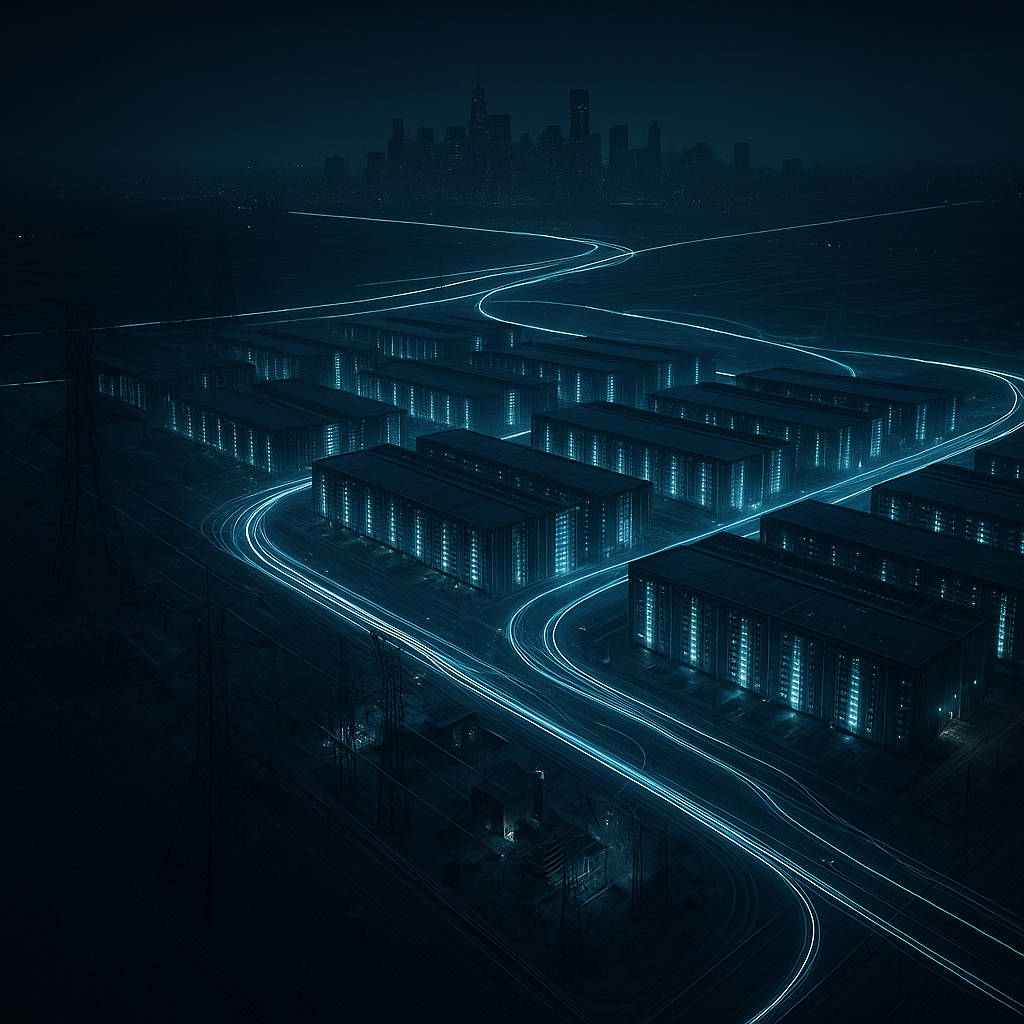
Over the past few days, the headlines looked straightforward.
Apple committing billions to AI data centers.
Google expanding global compute capacity.
Governments rolling out chip and manufacturing incentives.
Financial networks deploying AI at planetary scale.
On the surface, this feels like more of the same.
But this time, something is fundamentally different.
This Isn’t an AI Boom — It’s an Infrastructure Lock-In
In previous tech cycles, companies raced to build products.
Today, they’re racing to secure foundations.
The recent wave of announcements isn’t about better chatbots, smarter apps, or new features. It’s about owning the layers below the software — the parts users never see but competitors can’t easily copy.
Data centers.
Chips.
Energy-backed compute.
AI-ready logistics and security systems.
Once these are locked in, everything built on top becomes faster, cheaper, and harder to challenge.
Why Big Tech Is Spending Before Demand Fully Shows Up
Here’s the counterintuitive part:
Much of this spending is happening before AI demand fully peaks.
That’s intentional.
AI systems scale non-linearly. When demand explodes, compute becomes scarce overnight. The companies that prepared early don’t just survive — they dictate prices, standards, and access.
This is why Apple, Google, and others are investing now:
-
To avoid future bottlenecks
-
To control performance and reliability
-
To reduce dependence on external providers
-
To defend their ecosystems long-term
This is defensive strategy disguised as expansion.
Governments Are Treating Compute Like Critical Infrastructure
Another quiet but important signal from recent news: governments are no longer treating AI as “just technology.”
Semiconductor strategies, manufacturing subsidies, and national AI plans are now framed like:
-
energy security
-
supply-chain resilience
-
economic sovereignty
That’s a big shift.
When governments step in at this scale, it’s because the technology has crossed into strategic territory. Compute is being treated the way oil, steel, and electricity once were.
The Real Divide That’s Emerging
The world is slowly splitting into two groups:
-
Builders of AI infrastructure
-
Users of AI infrastructure
The gap between these groups will define:
-
economic power
-
innovation speed
-
long-term competitiveness
Recent news shows very clearly who wants to be in group one — and who is at risk of staying in group two.
Why This Matters More Than Any Single Announcement
Individually, each announcement feels incremental.
Together, they signal a point of no return.
Once AI infrastructure is built at this scale:
-
Entire industries reorganize around it
-
Costs collapse for those inside the system
-
Barriers rise sharply for late entrants
The future doesn’t arrive as a product launch.
It arrives as a locked door.
What INCX Insights Pays Attention To
INCX Insights doesn’t just track what was announced.
It tracks:
-
what kind of power is being accumulated
-
which layers are becoming scarce
-
and which moves are irreversible
Because the most important shifts don’t look exciting in the moment — until suddenly, they matter everywhere.