

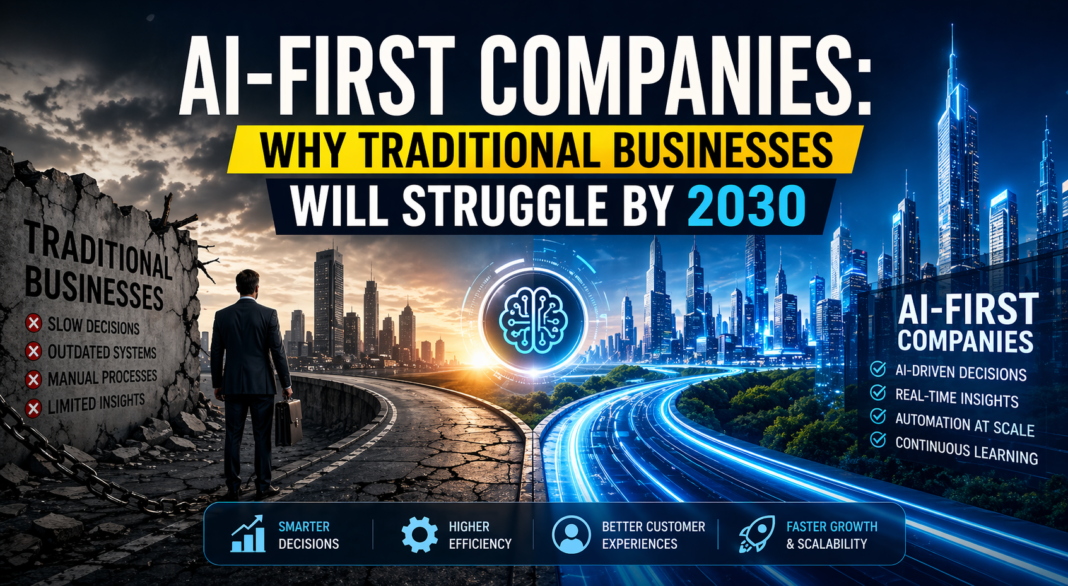

AI First companies; why traditional businesses will struggle by 2030.
The Day Traditional Businesses Became Obsolete
From 2023-2026 many companies are still experimenting with AI.by 2-3 years many more companies will scale with it, by 2030 many won’t exist this isn’t a prediction it’s a pattern. Big companies like Amazon, Flipkart, Netflix they didn’t just adopted AI- rebuilt themselves around it.
Many traditional companies upgraded themselves by adding chatbot, automated emails and called it digital transformation, but still wondering why growth stalled.
AI Powered vs AI First; The difference everyone ignores
THIS IS WHERE MOST FOUNDERS GET WRONG
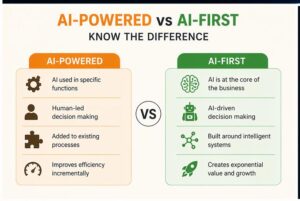 AI Powered companies
They use AI as a tool-update it on the latest system.
focus will be on improving efficiency
AI First companies
they build their entire company around AI model
use Data as core decision driver
Learn to adapt and optimize continuously
THIS IS WHERE THE GAP COME INTO PICTURE
Why will Traditional business struggle by 2030?
Speed will outpace structure
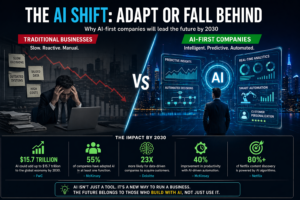
Traditional companies rely on meetings, approvals-take months for a single decision, while AI first companies use real time data and automated decision systems to make quick decisions.
A report by PwC suggests AI could contribute up to $15.7 trillion to the global economy by 2030, largely driven by productivity gains.
Businesses that cannot match this speed will fall behind.
Data will replace Intuition
From decades, business decisions were based on experience and assumptions. Nowadays AI can detect patterns and have greater accuracy.
According to Deloitte, data-driven organizations are 23x more likely to acquire customers and significantly more profitable.
Legacy system will become a barrier
Many traditional companies still work on outdated technology, which creates several challenges like slower innovation. While AI-first companies operate faster building business scalable.
Customers’ expectations are changing rapidly
Nowadays, consumers expect instant response and seamless interaction, AI-first companies are delivering this at scale.
For example, Netflix attributes a significant portion of its user engagement to its recommendation engine.
Similarly, Amazon drives a large share of its sales through AI-powered product recommendations.
Traditional businesses simply cannot match this level of personalization manually.
Core Pillars of AI-First companies
Data centric infrastructure
Automation at scale
Continuous learning system
Personalization engines
Predictive decision making
Real-World Examples of AI-First Thinking
Amazon
• Uses AI for logistics optimization
• Predicts demand before orders are placed
• Personalizes user experience at scale
Netflix
• Uses machine learning to drive content recommendations
• Reduces churn through predictive engagement
• Optimizes content investment decision
These companies are not just “using AI”—they are built on it.
What Businesses Should Do NOW (Practical Framework)
Step 1- Identify repetitive patterns and set automation
Step 2- Centralize and clean your data
Step 3- invest into AI capabilities
Step 4- Upskill your workforce
Step 5- shift leadership mindset
The 2030 reality; what will change
By 2030, we won’t be asking should we use AI? we would be asking how
A company could survive without it If traditional business failed to adapt AI, they would face issues like slower growth, declining margins and eventually turn irrelevant for the market.
Final thought
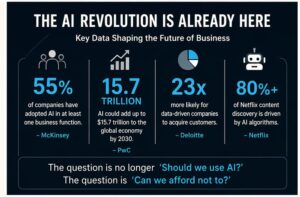
AI is not a future technology anymore-it’s already here, rewriting the rules faster than most business. Now the question is not about whether AI will transform your industry-
will you transform your business before it’s too late?