
Introduction
For decades, building a startup followed a familiar formula: founders hired engineers to build products, marketers to attract customers, and support teams to keep operations running. Growth was closely tied to headcount.
Today, that formula is being challenged.
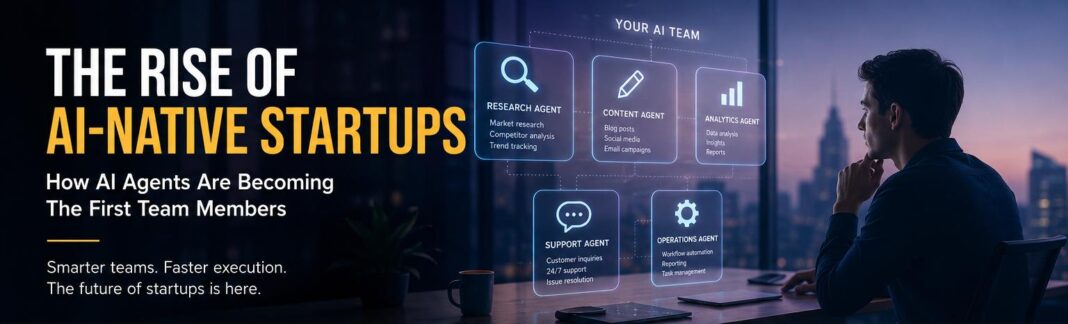
A growing number of founders are turning to AI agents as their first team members. These systems can conduct market research, generate content, analyze data, automate workflows, and handle customer inquiries—tasks that once required multiple employees.
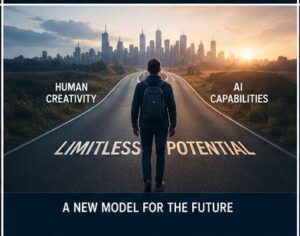
As a result, startups can achieve more with smaller teams, moving faster and operating more efficiently. This shift is not simply about reducing costs or increasing productivity. It represents a new way of building companies, where founders combine human creativity and strategic thinking with AI-powered execution.
The startup org chart is being rewritten, and the new model may look less like a traditional company and more like a founder leading a team of AI agents.
The Emergence of the AI-Native Startup
Every technological revolution changes the economics of business.The internet reduced the cost of distribution. Cloud computing reduced the cost of infrastructure. Artificial intelligence is now reducing the cost of execution.
In the past, a startup needed multiple specialists to move from idea to market. Today, AI tools can assist with tasks that traditionally required writers, researchers, analysts, designers, customer support representatives, and administrative staff.This does not mean human expertise is becoming obsolete. Rather, it means founders can operate with greater leverage than ever before.
A single entrepreneur equipped with the right AI systems can now accomplish what previously required a team of ten.
Meet the New Team Members
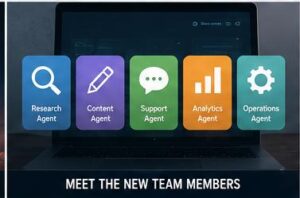
Modern startups still need teams, but not every team member is human. Today, founders can work alongside AI agents that handle specialized tasks. Research agents track market trends and competitors. Content agents create blogs, social posts, and marketing materials. Customer support agents answer questions around the clock, while analytics agents uncover insights from large datasets. Operations agents help automate workflows, reporting, and daily processes.
Together, these AI-powered assistants form a digital workforce that operates 24/7, scales instantly, and enables startups to achieve more with fewer resources.
Why Founders Are Turning to AI Agents
Startups have always operated under tight constraints. Limited budgets, small teams, and constant pressure to move quickly make efficiency essential.
AI agents help founders overcome these challenges by increasing productivity without increasing headcount.
- Faster Execution: Tasks that once took days can now be completed in hours.
- Lower Costs: Startups can achieve more without expanding payroll.
- Greater Scalability: AI systems can handle growing workloads without additional hiring.
- 24/7 Productivity: AI works continuously, helping businesses maintain momentum around the clock.
As AI takes over routine execution, human strengths become even more valuable. Founders provide vision, judgment, and strategic direction while AI handles much of the operational workload.
The founder’s role is shifting from doing everything to orchestrating teams of both people and AI.
The Limits of the AI Workforce
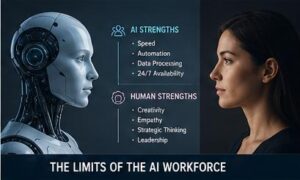
AI agents are becoming powerful contributors to modern startups, but they are not a substitute for people. Human strengths such as creativity, strategic thinking, empathy, leadership, and relationship-building remain essential for long-term success. AI can assist with execution and analysis, but it cannot fully replace the trust and judgment that humans bring to critical decisions.
As AI becomes more capable, the competitive advantage will not come from replacing people. It will come from knowing how to combine human expertise with AI-driven efficiency. The startups that thrive in the coming years will be those that treat AI as a powerful teammate rather than a replacement for their workforce.
The future belongs to organizations where humans and AI work side by side.