



Introduction
Startup fundraising in 2026 looks dramatically different from what it did just a few years ago. The rapid rise of artificial intelligence has transformed industries, accelerated innovation, and reshaped investor expectations. While capital continues to flow into promising startups, investors have become far more selective about where they place their bets.
In the past, a compelling vision and a large market opportunity were often enough to attract investor attention. Today, founders must demonstrate much more than ambition. Investors want evidence of execution, market validation, customer demand, and a sustainable path to growth.
The AI boom has also created a crowded startup ecosystem where thousands of companies claim to use artificial intelligence. As a result, investors are increasingly looking beyond AI buzzwords and focusing on businesses that solve real problems, generate measurable value, and possess long-term competitive advantages.
Understanding these new fundraising rules is essential for founders seeking startup funding in today’s highly competitive environment.
The Shift from Vision to Validation

Vision remains an important part of any startup story, but it is no longer enough on its own. Investors now prioritize validation over speculation.
Rather than relying solely on future projections, venture capital firms want evidence that customers genuinely need the product and are willing to pay for it. This shift reflects a broader market trend toward reducing investment risk and focusing on startups with proven demand.
Validation can take several forms:
- Early customer adoption
- Product-market fit
- Revenue generation
- Customer retention
- User engagement metrics
- Pilot programs and successful case studies
Startups that can demonstrate market validation are often viewed as lower-risk investments and stand a better chance of securing funding.
Why Execution Matters More Than Ever
One of the biggest changes in startup fundraising is the increased focus on execution. Investors have seen countless startups with innovative ideas fail because they could not successfully bring those ideas to market.
Today, investors want proof that founders can execute consistently and efficiently.
Key indicators of execution include:
- A functional product or minimum viable product (MVP)
- Growing customer acquisition
- Consistent revenue growth
- Strong customer retention
- Efficient use of capital
- Clear operational milestones
Founders who can demonstrate progress through measurable results are often more attractive to investors than those relying solely on ambitious projections.
The End of AI Hype: Investors Want Real Value

Artificial intelligence continues to attract investor interest, but the era of funding startups simply because they use AI is coming to an end.
Investors have become increasingly cautious about companies that position artificial intelligence as their primary differentiator without demonstrating clear customer value. Simply integrating AI into a product is no longer enough.
Instead, investors are asking critical questions:
- Does the AI solve a meaningful business problem?
- Does it improve efficiency or reduce costs?
- Is there a measurable return on investment for customers?
- Can competitors easily replicate the solution?
Startups that answer these questions effectively are more likely to stand out in an increasingly crowded AI marketplace.
Building Defensible Competitive Advantages
As AI technologies become more accessible, investors are focusing heavily on defensibility.
Many AI tools now rely on similar foundation models and technologies. As a result, investors are looking for advantages that competitors cannot easily copy.
These advantages may include:
- Proprietary datasets
- Industry-specific expertise
- Unique workflows
- Strong customer relationships
- Exclusive partnerships
- Network effects
A defensible business creates barriers to entry and increases the likelihood of long-term success, making it a more attractive investment opportunity.
Traction Is the Strongest Proof of Demand
In today’s fundraising environment, traction is one of the most powerful signals a startup can provide.
Traction demonstrates that customers value the product and that the business has the potential to scale. It reduces uncertainty for investors and provides evidence that the market opportunity is real.
Common traction indicators include:
- Increasing monthly recurring revenue (MRR)
- Growing customer base
- Expanding user engagement
- Strategic partnerships
- Strong customer retention rates
- Positive customer testimonials
A startup with measurable traction often has a significant fundraising advantage over competitors that are still operating primarily on assumptions.
The Metrics Investors Care About in 2026
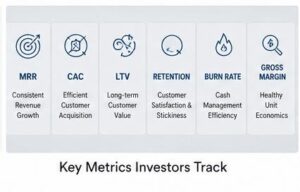
Modern investors rely heavily on data-driven decision-making. Founders should be prepared to discuss key performance metrics that demonstrate business health and scalability.
Some of the most important metrics include:
Monthly Recurring Revenue (MRR)
MRR helps investors understand the consistency and predictability of revenue growth.
Customer Acquisition Cost (CAC)
This metric measures how much it costs to acquire a new customer and indicates the efficiency of the company’s growth strategy.
Lifetime Value (LTV)
LTV estimates the total revenue generated by a customer over the duration of their relationship with the business.
Retention Rate
Strong retention suggests that customers find ongoing value in the product.
Burn Rate
Investors closely monitor how quickly a startup spends its available capital.
Gross Margin
Healthy margins indicate that the business can scale profitably over time.Startups that can demonstrate strong performance across these metrics are often viewed as more investment ready.
Capital Efficiency Has Become a Competitive Advantage
The fundraising environment has shifted toward greater financial discipline. Investors are increasingly favoring startups that achieve significant progress without excessive spending.
Capital-efficient startups demonstrate:
- Lean operations
- Disciplined hiring
- Strategic spending
- Sustainable growth
- Faster paths to profitability
Rather than rewarding startups for burning large amounts of capital in pursuit of growth, investors now value founders who can maximize results with limited resources.
Creating a Winning Investor Pitch

An effective investor pitch in the AI era must balance technological innovation with strong business fundamentals.
Founders should clearly communicate the following:
The Problem –Define the customer pain point and explain why it matters.
The Solution – Demonstrate how the product solves the problem more effectively than existing alternatives.
Market Opportunity –Use credible market data to show the size and growth potential of the opportunity.
Business Model– Clearly explain how the company generates revenue and plans to achieve profitability.
Competitive Advantage – Highlight the factors that make the business difficult to replicate.
Growth Strategy -Outline how the company plans to acquire customers, expand into new markets, and scale operations.
The most successful fundraising presentations are concise, data-driven, and focused on measurable outcomes rather than speculation.
Conclusion
The new rules of startup fundraising reflect a broader shift in investor priorities. While innovation remains important, venture capital firms are increasingly focused on execution, market validation, capital efficiency, and sustainable growth.
The AI era has created extraordinary opportunities for founders, but it has also raised the bar for securing investment. Investors are no longer funding ideas alone. They are investing in startups that can demonstrate customer demand, measurable traction, defensible advantages, and scalable business models.
Founders who combine technological innovation with strong business fundamentals will be best positioned to attract investors and build successful companies in 2026 and beyond.