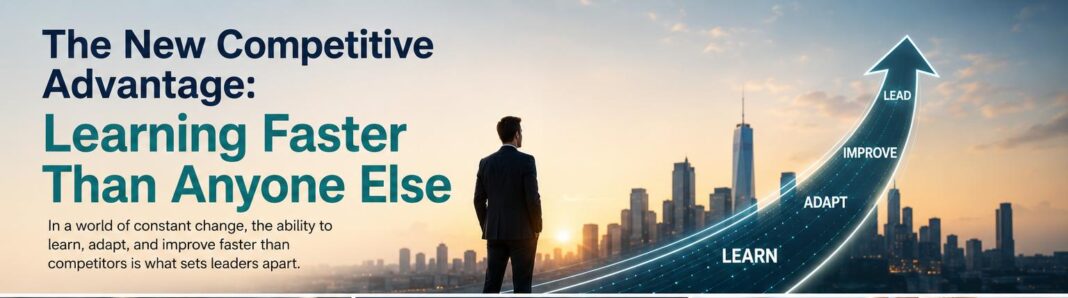
The Next Competitive Advantage: Organizational Learning Speed

Introduction

For much of business history, competitive advantage came from resources. Companies with larger budgets, stronger technology, and bigger teams often had a clear path to growth and market leadership. That advantage is becoming harder to sustain. Technology is easier to access, information moves instantly, and AI tools are available to organizations of every size.

What increasingly separates successful companies from the rest is their ability to learn and adapt. Organizations that can quickly understand new realities, experiment with new approaches, and apply lessons faster than competitors are better equipped to navigate uncertainty and seize emerging opportunities. In today’s business environment, the fastest learners are often the biggest winners.

The Shrinking Lifespan of Competitive Advantages

Business success is increasingly difficult to sustain through strategy alone. The pace of change has accelerated, making it harder for companies to rely on long-term assumptions. Consumer preferences shift, technologies evolve, and competitive landscapes can transform rapidly. In such an environment, even strong strategies have a shorter lifespan. Organizations that continually learn and adjust are better positioned to succeed than those that simply try to forecast the future.

The Shift from Knowledge to Learning
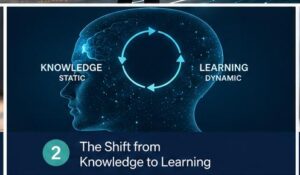
The competitive landscape is undergoing a fundamental transformation. For years, organizations sought advantage through expertise, experience, and proprietary knowledge. While these assets remain valuable, they are no longer sufficient in a world where change is constant, and disruption can emerge from any direction. The organizations creating sustained success are distinguished by their ability to learn faster than competitors. They continuously gather feedback, challenge assumptions, and refine their decisions based on new information. Learning has evolved from a supporting function into a strategic capability. As knowledge becomes increasingly perishable, learning speed is becoming the most reliable source of long-term advantage.

Learning as a Competitive Capability

Learning is no longer just an HR initiative. It is becoming a core business capability.The most successful organizations treat every project, customer interaction, and market shift as an opportunity to gather insights and improve. They create systems that capture knowledge, challenge assumptions, and spread lessons across teams.As a result, they do not simply execute well—they improve their execution with every cycle.

Why AI Raises the Stakes

The rise of AI makes learning speed even more valuable. While access to AI tools is becoming increasingly common, the ability to use those tools effectively remains a differentiator. Companies that use AI only for automation may gain efficiency. Companies that use AI to accelerate learning gain something far more powerful: the ability to adapt faster than competitors. As markets become more dynamic, the organizations that learn the fastest will be the ones most likely to lead.

The Compounding Effect of Continuous Learning

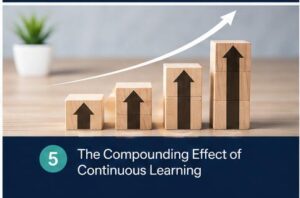
The true value of organizational learning lies in its ability to compound over time. Small improvements made consistently may seem insignificant in the short term, but they create substantial advantages over the years. Every customer interaction, project, and experiment generates insights that help organizations make better decisions. As learning becomes embedded in daily operations, improvement accelerates, creating a cycle where better outcomes lead to better knowledge and even stronger performance. This compounding effect is what separates industry leaders from competitors that struggle to keep up.

Building a culture that accelerates learning

Fast-learning organizations recognize that valuable ideas can come from anywhere. They create workplaces where employees are comfortable expressing different perspectives and exploring new approaches. This openness not only strengthens collaboration but also helps organizations identify emerging challenges and opportunities before competitors do.

The Future Belongs to Adaptive organisations

Success in the coming years will depend less on what organizations know today and more on how quickly they can learn tomorrow. Businesses that develop strong learning capabilities can evolve alongside changing customer needs, emerging technologies, and shifting market conditions. Their ability to adapt will be a defining factor in their long-term growth and resilience.


Latest news

All Categories

Related Posts