


Introduction
Artificial Intelligence (AI) is transforming how businesses operate, helping automate tasks, improve customer experiences, and support better decision-making. Yet many AI initiatives fail to deliver their expected value—not because the technology is lacking, but because the business information behind it is disorganized. According to McKinsey, while AI adoption continues to grow rapidly, many organizations still face challenges related to data quality, governance, and organizational readiness.
When company knowledge is scattered across emails, shared drives, outdated documents, and multiple systems, AI cannot consistently deliver accurate results. Before investing in AI, businesses must first build a strong knowledge management (KM) strategy.
What Is Knowledge Management?
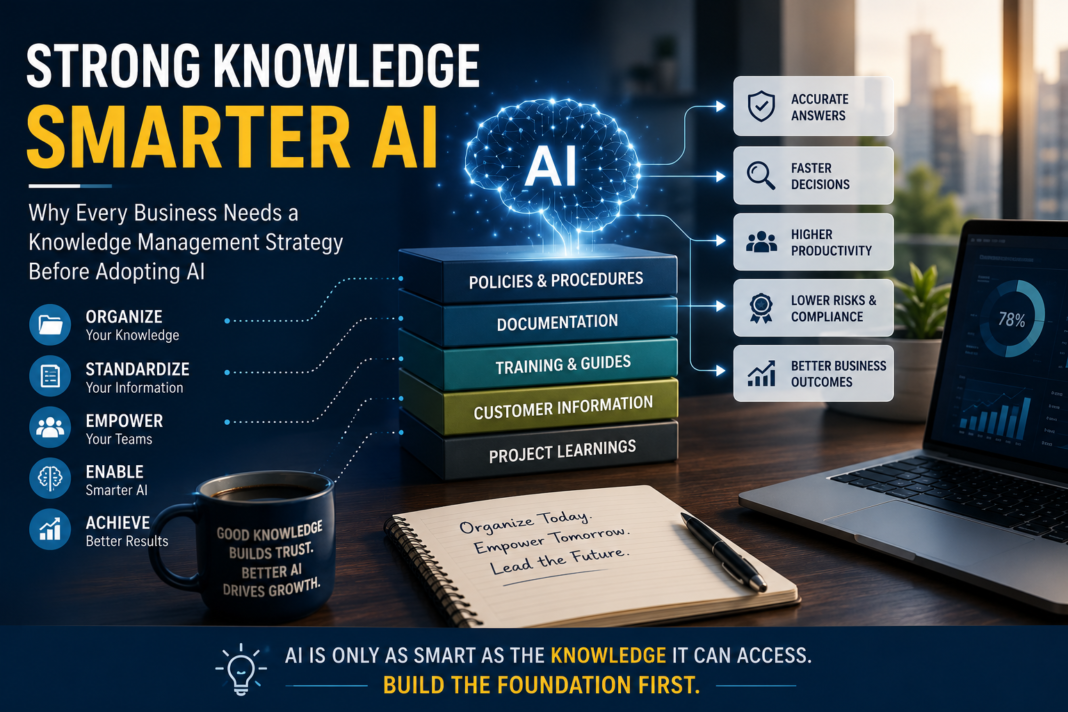
Knowledge Management (KM) is the process of capturing, organizing, storing, updating, and sharing an organization’s knowledge. This includes policies, standard operating procedures (SOPs), product documentation, customer information, training materials, and project learnings.
A well-managed knowledge base creates a single source of truth, allowing employees to quickly access reliable information instead of searching through multiple files or relying on colleagues.
Why AI Depends on Good Knowledge
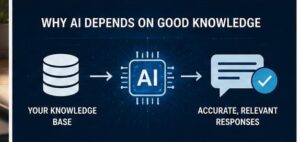
Generative AI has broad general knowledge, but it does not understand your organization’s internal processes unless that information is available in a structured format. Modern enterprise AI often uses Retrieval-Augmented Generation (RAG), which retrieves information from a company’s knowledge base before generating responses. If the knowledge base contains outdated or conflicting information, AI is likely to produce inaccurate or inconsistent answers. Simply put, AI cannot create trustworthy answers from unreliable knowledge.
The Hidden Cost of Poor Knowledge Management

Poor knowledge management affects organizations long before AI is introduced. Employees spend valuable time searching for documents, confirming procedures, or identifying the latest version of important files. These inefficiencies reduce productivity, slow decision-making, and increase operational costs. When AI is added to this environment, it often amplifies these existing problems rather than solving them.
Why Businesses Should Build a Knowledge Strategy First
A successful AI strategy begins with organized knowledge. Before implementing AI, businesses should:
-
Create a single source of truth for business information.
-
Standardize documentation and naming conventions.
-
Remove outdated or duplicate content.
-
Encourage employees to share knowledge consistently.
-
Define clear access permissions and governance policies.
These practices ensure that AI retrieves accurate, up-to-date information while improving collaboration across teams.
Real-World Example
Organizations such as Microsoft, Atlassian, and ServiceNow have invested heavily in enterprise knowledge management because modern AI performs best when it can retrieve information from trusted internal sources. Microsoft’s AI assistants, for example, are designed to work with an organization’s documents, emails, and knowledge repositories to provide context-aware responses rather than relying solely on general AI knowledge.This highlights an important lesson: the value of AI depends not only on the model itself but also on the quality, accuracy, and organization of the knowledge it can access
Benefits of Knowledge Management Before AI
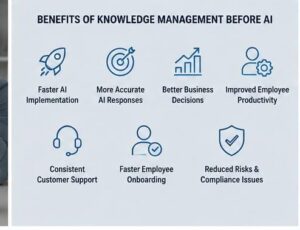
Organizations that establish a strong knowledge management foundation before adopting AI can expect:
-
Faster AI implementation and deployment.
-
More accurate AI-generated responses.
-
Better business decisions based on trusted information.
-
Improved employee productivity.
-
Consistent customer support.
-
Faster employee onboarding.
-
Reduced compliance and operational risks.
AI and Knowledge Management Work Better Together

Knowledge management and AI are complementary technologies. Knowledge management ensures business information is accurate and well-organized, while AI helps employees search, summarize, analyze, and use that knowledge more efficiently. Together, they create an intelligent workplace where information drives faster decisions and greater productivity.
Conclusion
Businesses often focus on choosing the right AI platform while overlooking the quality of the information that powers it. However, AI is only as effective as the knowledge it can access. Organizations that invest in knowledge management before adopting AI are better positioned to achieve reliable results, improve productivity, and gain a sustainable competitive advantage. In the age of AI, organized knowledge is no longer just good practice—it is the foundation of successful AI adoption.