


Introduction
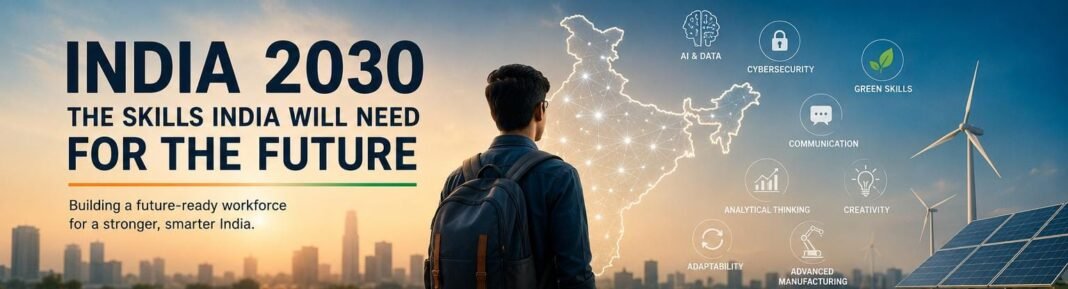
India is entering a defining decade. By 2030, the country will not compete only on the basis of its large population, growing economy or expanding consumer market. Its real advantage will increasingly depend on the skills of its people. Artificial intelligence, automation, green energy, advanced manufacturing, digital infrastructure and the expansion of Global Capability Centres (GCCs) are already transforming the nature of work. The question is no longer whether jobs will change, but whether India’s workforce can evolve quickly enough to keep pace with them.
The scale of this challenge is enormous. According to the Ministry of Skill Development and Entrepreneurship, India has around 67.28 crore people of working age, while approximately 10 million people enter the labour force every year. At the global level, the World Economic Forum’s Future of Jobs Report 2025 estimates that 39% of workers’ existing core skills could change or become outdated between 2025 and 2030. This means India’s demographic advantage can become a powerful economic advantage only if its workforce is equipped with the right combination of technical, analytical and human skills.
Why Skills Will Matter More Than Degrees
For decades, a university degree was often considered the primary indicator of employability. But the workplace of 2030 will look very different. A graduate entering the workforce may work alongside AI systems, analyse real-time data, collaborate with international teams and continuously learn new digital tools.
The traditional equation of “degree equals job” is therefore gradually changing into “education plus skills plus experience plus adaptability equals career.” India’s expanding Global Capability Centre ecosystem is a good example. GCCs are increasingly moving beyond traditional back-office operations into areas such as artificial intelligence, analytics, engineering, cybersecurity and research. As companies demand more specialised capabilities, simply having a degree may not be enough. Employers will increasingly look for people who can demonstrate what they can actually do.
AI Literacy Will Become a Basic Workplace Skill
Artificial intelligence is likely to be one of the most important forces shaping India’s workforce by 2030. However, AI literacy will not mean that everyone needs to become an AI engineer. A marketing professional may use generative AI to analyse customers and create campaign ideas. A financial analyst may use AI to process large amounts of financial data. A teacher may use AI to personalise learning, while a healthcare professional may work with AI-assisted diagnostic systems.
This means future workers will need to understand how AI works at a basic level, how to use generative AI tools, how to write effective prompts, how to verify AI-generated information and how to use AI responsibly. The advantage will increasingly belong to professionals who know how to combine AI with their existing expertise. AI may not replace every professional, but professionals who understand how to use AI effectively could have a significant advantage over those who do not.
Data Literacy Will Become Essential

India is becoming increasingly data-driven. Digital payments, e-commerce, financial technology, healthcare platforms, government digital services and connected devices are generating enormous quantities of information. But data has little value if people cannot understand it and convert it into useful decisions.
Data literacy will therefore become important far beyond traditional technology jobs. Professionals will need to understand spreadsheets, dashboards, basic statistics, data visualisation and data interpretation. Consider two marketing managers. One may simply say that sales are falling, while another may identify that sales have declined by 12% among a particular customer segment and that mobile conversion rates have dropped significantly. The second manager is using data to identify a problem and make a decision. By 2030, this ability to move from information to insight will be valuable across industries.
Cybersecurity Will Protect India’s Digital Economy

As India’s digital economy expands, cybersecurity will become increasingly important. Banks, hospitals, government departments, startups, manufacturers and small businesses are becoming more dependent on connected digital systems. This creates a growing need for cybersecurity professionals who understand cloud security, network protection, identity management, ethical hacking, data protection and AI security.
India is already experiencing a shortage of specialised cybersecurity talent. A recent SANS Institute–DSCI study found that 57% of cybersecurity firms surveyed struggled to hire AI/ML security specialists. This indicates that cybersecurity skills will become increasingly valuable as businesses adopt AI and digital technologies. At the same time, cybersecurity will no longer be only an IT department’s responsibility. Ordinary employees will also need basic knowledge of phishing, password security, data protection and responsible digital behaviour.
Analytical and Critical Thinking Will Become More Valuable

AI can process information at remarkable speed, but humans still need to decide what that information means. This is why analytical and critical thinking will remain among the most important skills of the future.
Analytical thinking involves breaking complex problems into smaller parts, identifying patterns, evaluating evidence and making logical decisions. Imagine a financial analyst using AI to process thousands of financial statements. The technology may identify unusual patterns, but the analyst still needs to ask why profits are falling, whether the problem is temporary or structural, whether the company’s growth is sustainable and what risks may be hidden in the numbers.
The ability to question information rather than simply accept it will become even more important in an age of AI-generated content and misinformation. India’s future workforce will need people who can combine technological tools with human judgement.
Creativity Will Become a Competitive Advantage

The rise of AI might make creativity seem less important because machines can now generate text, images, videos and ideas within seconds. In reality, the opposite may happen. When producing content becomes easier, original thinking becomes more valuable.Companies will need people who can identify new opportunities, develop products, solve unfamiliar problems and create meaningful experiences for customers.
Two companies may have access to exactly the same AI tools, but the company that asks better questions and develops more original ideas can still gain an advantage.Creativity will therefore move beyond being considered a “soft skill.” It will become an important part of innovation and competitiveness.
Communication and Human Skills Will Remain Essential

Technology may change how people work, but organisations will continue to depend on human relationships. Employees will still need to explain ideas, negotiate, collaborate, lead teams, resolve disagreements, communicate with customers and work across cultures.This will be particularly important as Indian companies become more connected to international markets. A technically skilled employee who cannot explain ideas clearly or work effectively with others may struggle to create significant impact.
The future professional will therefore need a combination of technical expertise and human skills such as communication, emotional intelligence, collaboration and leadership. These capabilities are difficult to automate completely because they depend on context, relationships and human judgement.
Adaptability May Become the Most Important Skill

Perhaps the most important skill for 2030 will not be a particular technology at all. It will be the ability to learn continuously.
Technology is evolving so quickly that skills considered valuable today may change within a few years. Professionals have already moved from traditional software to cloud platforms, from manual analysis to automated dashboards and from conventional search to AI-powered assistants. The tools of 2030 will likely be different again.
The World Economic Forum estimates that 39% of existing core skills will change by 2030, while 63% of employers identify skills gaps as a major barrier to business transformation. This makes continuous learning essential. The most valuable employee may not necessarily be the person who knows the most today, but the person who can learn and adapt the fastest tomorrow.
Green Skills Will Support India’s Sustainable Future
India’s economic growth will also be closely connected with the transition towards a more sustainable economy. Renewable energy, electric vehicles, battery technology, sustainable construction, waste management and energy efficiency are expected to create new employment opportunities.The World Bank has highlighted India’s efforts to identify emerging green occupations through the Skill Council for Green Jobs. Future professionals may work in renewable energy, environmental management, carbon accounting, sustainable manufacturing, climate-risk analysis and sustainable supply chains.
The green transition will require both highly specialised professionals and technically trained workers. This means green skills will not belong to one particular profession. They will increasingly become part of India’s broader workforce.
Advanced Manufacturing Will Create New Technical Careers
India’s ambition to become a global manufacturing hub will also change the skills required from industrial workers. Factories are increasingly combining traditional manufacturing with robotics, automation, artificial intelligence, industrial Internet of Things systems and computer-controlled machinery.The worker of the future may therefore do much more than operate a machine. They may need to monitor systems, identify technical problems, analyse performance and optimise processes.
Government skill-development initiatives are already identifying emerging opportunities in areas such as advanced manufacturing, drone operations, agri-tech, GIS and solar power. As manufacturing becomes more technologically sophisticated, India will need technicians who understand both physical machinery and digital systems.
Digital Entrepreneurship Will Open New Opportunities

India’s future workforce will not consist only of traditional employees. Digital platforms, affordable technology and AI are lowering the barriers to entrepreneurship.A young person can now build an online brand, sell products through digital platforms, offer consulting services, create educational content, work with international clients or build an AI-enabled startup without requiring the infrastructure that previous generations needed.
This could be especially important for India’s Tier-2 and Tier-3 cities. As digital connectivity improves, talented individuals will increasingly be able to participate in the national and global economy without necessarily moving to traditional metropolitan hubs.
The Rise of Multidisciplinary Professionals
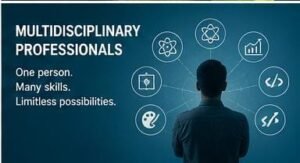
One of the most important characteristics of the 2030 workforce will be the ability to combine different fields of knowledge.A healthcare professional who understands AI, a finance professional who understands data analytics, a marketer who understands psychology and automation, or an HR professional who understands people analytics and AI can bring together multiple areas of expertise.
This is often described as being a “T-shaped professional.” The vertical part represents deep expertise in one field, while the horizontal part represents knowledge of complementary areas. India’s future workforce will increasingly need professionals who can combine domain expertise with technology, communication and problem-solving skills.
Practical and Vocational Skills Will Matter Too
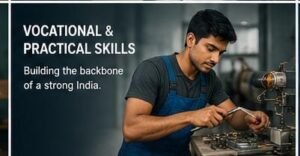
India’s future cannot be built only through university graduates. The country will also require electricians, technicians, healthcare workers, solar installers, machine operators, logistics professionals, drone operators and skilled tradespeople.Government programmes such as the Pradhan Mantri Kaushal Vikas Yojana, Industrial Training Institutes and Skill India Digital Hub are contributing to India’s wider skilling ecosystem. The bigger challenge is changing the perception of vocational education.
A skilled technician is not “less educated.” In a technology-driven economy, practical expertise can be just as valuable as academic knowledge. India’s manufacturing, construction, renewable-energy and infrastructure ambitions will depend heavily on this workforce.
What India’s Students Need to Do Now
For Indian students, the changing job market sends an important message: a degree alone may not be enough, but collecting certificates without practical experience will not be enough either.Students should focus on building evidence of their skills. Someone interested in digital marketing can build a campaign. A student interested in data analytics can create a dashboard. Someone interested in AI can demonstrate how they used an AI tool to solve a real problem. A student interested in finance can conduct a company analysis and create an investment research report.The question employers increasingly want answered is simple: What can you actually do?
This makes internships, projects, portfolios, apprenticeships, practical assignments and real-world experience increasingly important.
India’s 2030 Skills Stack
India’s future workforce will need a combination of technical knowledge, human capabilities and industry expertise. AI and data skills will provide technological capability, while analytical thinking and creativity will help people solve problems. Communication, leadership and collaboration will allow them to work effectively with others. Adaptability will enable them to remain relevant as technology changes, while green and technical skills will support India’s manufacturing and sustainability ambitions.
In simple terms, the formula for becoming future-ready can be expressed as:
Domain Expertise + Technology + Human Skills + Adaptability = Future Readiness
This combination will be more powerful than any single qualification.
The Real Challenge Is Not Technology — It Is Skills
India already has access to many of the technologies required for the next decade. The bigger challenge is ensuring that people can use those technologies effectively and responsibly.The scale of India’s skilling challenge is enormous because millions of young people will enter the workforce while millions of existing workers will need to reskill. India’s approach therefore cannot focus only on elite technology professionals. Students, workers, entrepreneurs, rural communities, women, vocational workers and small businesses all need access to relevant learning opportunities.
India’s Skill India Digital Hub crossed 1.5 crore registered candidates by February 2026, showing the scale at which digital skilling infrastructure is expanding. The platform provides industry-aligned learning opportunities and digital credentials, helping bring skills development into the digital age.The challenge now is to ensure that these opportunities translate into meaningful employment, entrepreneurship and productivity.
Conclusion: India’s Future Will Be Built by Its Skilled Workforce
India’s 2030 story will not be written by technology alone. AI can provide tools, digital infrastructure can provide access and investment can provide resources, but people will turn those opportunities into economic growth.India’s enormous working-age population gives the country a significant demographic opportunity. But demographics become an advantage only when people have the skills to participate productively in the economy.
The definition of being “educated” may therefore change over the next decade. It will not simply mean having a degree. It will increasingly mean being able to learn, adapt, think critically, communicate effectively, create new solutions and work confidently with technology.The most future-ready Indian will not necessarily be the person who knows exactly what the world of 2030 will look like. It will be the person who is prepared to keep learning as that world changes.
India 2030 will belong to a workforce that does not fear change but learns how to turn change into opportunity.
The future of India is not just a technology story. It is a skills story.