


Part 3 of the India 2030 Series
In the first article of the India 2030 series, we looked at the forces that could shape India’s next phase of growth. The second article explored whether manufacturing could become one of those engines by creating jobs, expanding exports and helping India move deeper into global supply chains. But there is another force that could change almost every sector at the same time: artificial intelligence.
AI is no longer a technology limited to research laboratories or technology companies. It is moving into factories, banks, hospitals, classrooms, government offices, farms and small businesses. The question for India is therefore no longer whether AI will arrive. It has already arrived. The bigger question is what India does with it.
By 2030, AI could influence how Indian companies produce goods, how governments deliver services, how students learn, how doctors diagnose diseases, how farmers make decisions and how businesses compete globally. It could raise productivity and create entirely new industries. At the same time, it could disrupt existing jobs and widen the gap between people who can work effectively with AI and those who cannot.
For India, the AI opportunity is therefore much bigger than building another successful technology industry. It is about whether a country with more than a billion people can use artificial intelligence to accelerate economic development.
India’s AI Moment Has Already Begun
India enters the AI era with several advantages. It has a large technology workforce, one of the world’s biggest pools of engineering talent, a rapidly expanding digital economy and a population already accustomed to digital public services.
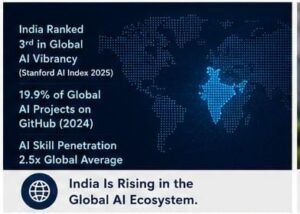
India’s position in the global AI ecosystem is also becoming more visible. A government backgrounder released in February 2026, citing Stanford’s 2025 AI Index, placed India third in the Global AI Vibrancy Ranking. The same source reported that India’s relative penetration of AI skills was 2.5 times the global average across comparable occupations. It also noted that India was the world’s second-largest contributor to AI projects on GitHub in 2024, accounting for 19.9% of projects.
These numbers matter because India’s advantage may not come from competing with the United States or China purely on the amount of computing power or capital available. India’s opportunity could come from combining technical talent with its enormous domestic market and its experience in building technology for very large and diverse populations.India has already demonstrated that it can build digital infrastructure at extraordinary scale. The next challenge is turning that digital foundation into an AI-powered economy.
From Digital India to AI India
The story of India’s digital transformation provides an important clue about what could happen next. Over the past decade, India has built digital systems that have changed how people make payments, access government services, open bank accounts and interact with businesses. The expansion of digital public infrastructure has created an environment in which new technology can reach hundreds of millions of people quickly.
AI could build on top of this foundation.
Imagine a small business owner who previously needed an accountant to understand complicated financial information. An AI assistant could help explain cash flows, prepare basic reports and identify unusual expenses. A farmer could receive agricultural information in a local language through a voice interface. A student in a small town could use an AI tutor that explains a difficult concept at their own pace. A government employee could use AI to process documents and identify patterns across large datasets.The important point is that AI does not have to be revolutionary in isolation. Its economic impact could come from being embedded into millions of existing activities.That is where India’s scale becomes important.
The Government Is Betting on an AI Ecosystem

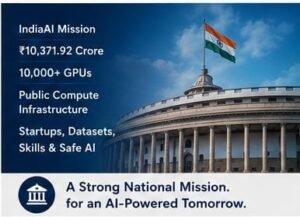
India has also begun building a national AI ecosystem through the India AI Mission. In March 2024, the Union Cabinet approved the India AI Mission with a budget outlay of ₹10,371.92 crore. The mission includes programmes focused on computing infrastructure, indigenous AI capabilities, datasets, future skills, startup financing and safe and trusted AI. It also envisages creating public AI compute infrastructure with more than 10,000 GPUs through public-private partnerships. The significance of this approach is that India is not treating AI simply as a software problem.
AI requires computing power, high-quality data, skilled people, research capabilities, startups, investment and governance. Without these pieces, having a large number of AI users does not necessarily translate into having a strong AI economy.India’s policy challenge is therefore to build an ecosystem where companies can experiment, researchers can develop new models, startups can access computing resources and businesses can actually deploy AI at scale.
India Does Not Need to Build Everything From Scratch
There is sometimes a tendency to frame the AI race as a competition to build the world’s largest or most powerful AI model.For India, that may not be the only—or even the most useful—measure of success.India could create enormous value by becoming exceptionally good at applying AI to its own economic and social challenges.
Healthcare is one example.
India has a shortage of doctors relative to its population, while healthcare demand is spread across major cities, smaller towns and rural areas. AI systems could assist doctors with medical imaging, help identify patterns in patient data, support administrative work and make specialist knowledge more accessible.
Agriculture presents another opportunity. AI can combine weather information, satellite imagery, soil data and historical crop patterns to help farmers make better decisions about irrigation, sowing and crop management.
Education is another area where the scale of the opportunity is enormous. An AI tutor capable of communicating in multiple Indian languages could potentially provide personalised assistance to students who do not have access to high-quality private tutoring.These applications may not always make international headlines, but they could have a much larger impact on India’s development than simply producing another chatbot.
The Indian Language Advantage
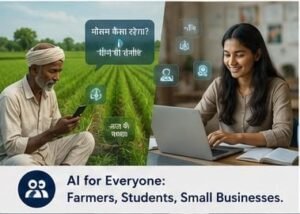
India’s linguistic diversity could also become an unexpected advantage.Much of the early internet and AI ecosystem was built around English. But India has hundreds of millions of people who primarily communicate in Indian languages.This creates a huge opportunity for AI systems that can understand and generate languages such as Hindi, Bengali, Tamil, Telugu, Marathi and many others.
The importance goes beyond translation.
If AI interfaces become genuinely conversational and multilingual, people who have limited comfort with English could interact with digital services through their own languages. A person could ask a government service a question verbally rather than navigating a complicated website. A farmer could receive information through voice. A small entrepreneur could use AI without needing to become fluent in technical English.This could make AI one of the next major stages of digital inclusion.It could also create an opportunity for Indian companies to develop technology specifically suited to multilingual and low-resource environments.
From AI Users to AI Creators
India’s startup ecosystem could become an important part of this transition.
But there is a major difference between using AI and building with AI.A recent report on India’s workforce illustrates this gap. Among more than 2,000 learners surveyed by upGrad, 94% said they were already using AI tools in some form, but only 26% had integrated AI through APIs or connected it to other tools, while just 20% had developed AI-powered automations, agents or applications.
The numbers should not be treated as a measure of the entire Indian workforce because the survey was conducted among a specific learner population. But the underlying distinction is important.India could become a country where millions of people use AI without becoming a country that produces enough AI products, infrastructure and intellectual property.That would limit the economic value India captures.
The bigger opportunity is to move from AI consumption to AI creation.
That means building startups, models, applications, AI infrastructure and specialised systems for sectors such as healthcare, finance, manufacturing, agriculture and education.
The Startup Opportunity
The country already has one of the world’s largest startup ecosystems, and AI is creating a new category of companies that can build products with relatively small teams.A traditional software company might need a large engineering team to build a complex product. Generative AI and AI development tools can reduce some of the time and resources required to prototype, test and deploy software.
This could lower barriers to entrepreneurship.
A small team in Bengaluru, Hyderabad, Pune or even a smaller Indian city can potentially build a product for a global market from day one.But this also creates a new problem: if AI makes software development easier for everyone, simply being able to build software will no longer be a major competitive advantage.The advantage will increasingly come from proprietary data, deep domain knowledge, distribution, trust and the ability to solve a problem better than competitors.
AI Could Transform Manufacturing Too

This is where the previous article in the India 2030 series connects directly with this one.Manufacturing and AI should not be viewed as separate stories.
The factory of 2030 could be an AI-powered factory.
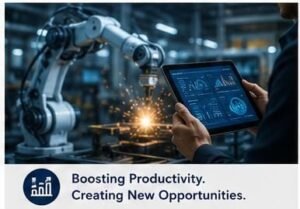
AI can be used for predictive maintenance, automated quality inspection, demand forecasting, supply-chain optimisation, inventory management and production planning. Computer vision systems can identify defects that humans might miss. Predictive systems can identify when machinery is likely to fail before an expensive breakdown occurs.This could make Indian manufacturing more productive without relying solely on cheaper labour.
That is important because India’s manufacturing competitiveness cannot remain dependent on wages forever. If Indian factories can combine relatively competitive costs with advanced technology, skilled workers and large-scale production, they could become significantly more competitive globally.In this sense, AI could amplify the manufacturing opportunity discussed in the previous article.
AI Could Also Change India’s IT Advantage

There is, however, a difficult side to the AI story.For more than three decades, India’s IT services industry has benefited from a large pool of technically skilled, English-speaking workers providing software development, business-process services and technology support to global companies.
Generative AI is beginning to challenge parts of that model.
NITI Aayog’s 2025 roadmap on job creation in the AI economy warned that India’s technology-services industry could face significant job displacement by 2031, while also identifying the potential to create up to four million new jobs over the following five years if India manages the transition successfully.This is an important distinction.
AI does not necessarily mean that India’s technology industry disappears.It means the economics of the industry could change.If an AI system allows one developer to complete work that previously required several people, companies may need fewer workers for certain routine tasks. At the same time, demand could increase for people who can design AI systems, integrate them into businesses, manage AI products, analyse data, ensure security and build new technology.The relationship between revenue and headcount could therefore become less linear.
For India, this is both a risk and an opportunity.
The Real AI Challenge Is Jobs
The AI debate often gets reduced to one question: “Will AI take our jobs?”
The more useful question is:
Which tasks will disappear, which jobs will change, and which new jobs will emerge?
A government response to Parliament in March 2026 cited NASSCOM estimates that India’s AI talent pool could grow from around 6–6.5 lakh professionals to more than 12.5 lakh by 2027, representing roughly 15% annual growth. It also noted that 8.65 lakh candidates had enrolled or been trained through various programmes, including 3.2 lakh in AI and big-data technologies.
At the same time, the latest evidence suggests that AI-related hiring is increasing. A government backgrounder citing Stanford’s AI Index reported that AI-related job postings in South Asia more than doubled from 2.9% of vacancies in January 2023 to 6.5% by March 2025, while demand for AI skills grew faster than demand for non-AI skills.
The implication is clear.
India’s challenge is not simply to produce more AI engineers.It needs workers across many professions who know how to work with AI.
A lawyer who can use AI effectively, a designer who can work with generative tools, a teacher who can build personalised learning materials, a doctor who understands AI-assisted diagnostics and a factory technician who can operate AI-enabled machinery may all become more valuable.
The future workforce may therefore not be divided into “AI workers” and “non-AI workers”.It may increasingly be divided between workers who know how to use AI effectively and those who do not.
The Risk of an AI Divide
This creates another challenge for India.
Technology can increase productivity, but its benefits are not automatically distributed equally.Workers with better education, stronger digital skills and access to technology are more likely to benefit first. People working in routine occupations may face greater disruption.
That could create a new form of inequality: not simply between people who have access to the internet and those who do not, but between people who can use advanced AI productively and those whose jobs are increasingly automated.
This makes skilling central to India’s AI strategy.India’s AI opportunity will not be measured only by the number of GPUs it has or the number of startups it produces. It will also depend on whether an ordinary student, worker or small business owner can participate in the AI economy.
Why India’s AI Opportunity Is Different
India is not starting from the same position as the United States or China.It does not have the same level of private AI investment or computing infrastructure as the world’s biggest technology economies.
But India has other advantages.
- It has scale.
- It has a large technology workforce.
- It has a young population.
- It has a huge domestic market.
- It has extensive digital infrastructure.
And it has a remarkable real-world testing environment because Indian companies and governments have to solve problems involving enormous populations, multiple languages and very different income levels.If India can build AI solutions that work under these constraints, those solutions may also have markets across the developing world.
That could become an important export opportunity.India has already exported software services to the world.The next generation could involve exporting AI-powered products and solutions.
The Global AI Race Is Also a Race for Compute
There is another reality that India cannot ignore.AI requires enormous computing resources.Training and running advanced models depends on specialised chips, data centres, electricity and high-speed networks. This makes compute infrastructure a strategic economic resource.
The IndiaAI Mission’s plan to develop access to more than 10,000 GPUs is therefore significant. The objective is not simply to give researchers faster computers. It is to reduce one of the barriers that can prevent startups and researchers from experimenting with advanced AI.
But India will need to think beyond the number of GPUs.It will need data centres, reliable power, cooling infrastructure, semiconductor capabilities, research institutions and companies capable of turning compute into commercially valuable products.
AI infrastructure could become as strategically important in the 2030s as telecommunications infrastructure was during the earlier digital transformation.
Regulation Will Shape the AI Economy
The more powerful AI becomes, the more important governance becomes.AI systems can create inaccurate information, reinforce biases, expose sensitive data or be misused for fraud and manipulation. Businesses need to know what they are allowed to do with AI-generated information, how data should be handled and who is responsible when an automated system makes a harmful decision.
India therefore faces a delicate balancing act.
Too little regulation can undermine trust.
Too much regulation can discourage experimentation and innovation.The goal should be to create an environment where companies can innovate while citizens have meaningful protections.
The India AI Mission itself includes a Safe and Trusted AI component, reflecting the government’s recognition that building AI capability and building responsible AI systems need to happen together.
What Could AI Mean for India by 2030?
By 2030, the most important impact of AI may not be a single revolutionary invention.It may be thousands of smaller improvements happening simultaneously.A factory producing more with the same workforce. A bank processing applications faster. A hospital helping doctors analyse medical images. A teacher supporting students outside the classroom. A farmer receiving better information about crops. A government department processing paperwork more efficiently. A small business reaching international customers with AI-powered marketing and translation.
Each individual change may appear small.Together, they could significantly increase productivity.And productivity is ultimately what determines how much an economy can produce with the resources it has.For India, this matters enormously.A country with a large population cannot rely only on adding more workers to generate growth. It needs each worker, machine and unit of capital to become more productive.AI could help make that possible.
But AI Alone Will Not Transform India
There is a temptation to view AI as a magic solution to India’s development challenges.It is not.AI cannot compensate for poor infrastructure, weak education, unreliable electricity or inefficient institutions. A farmer cannot benefit from an AI recommendation if there is no reliable irrigation system. A small manufacturer cannot become globally competitive through AI alone if its logistics costs remain too high. A student cannot benefit from an AI tutor if they do not have reliable internet access or foundational education.
Technology amplifies existing capabilities.
If the foundations are strong, AI can make them stronger.
If the foundations are weak, AI cannot fix everything.
This is why India’s AI strategy needs to be connected to the broader India 2030 story: manufacturing, education, infrastructure, skills, healthcare, energy and entrepreneurship must develop alongside technology.
The Bigger India 2030 Question
The real AI question for India is therefore not:
“Can India build the next ChatGPT?”
It is much bigger.
Can India use artificial intelligence to make its entire economy more productive, innovative and inclusive?
That is the opportunity.
India could become a major consumer of AI. It could become one of the world’s largest pools of AI talent. It could build startups that sell AI products globally. It could develop models designed for Indian languages and conditions. And it could use AI to improve manufacturing, healthcare, agriculture, education and public services.But the risks are equally real.
Jobs will change. Some roles will disappear. Skills will become obsolete faster. The gap between AI-capable workers and everyone else could widen. Companies that fail to adapt could lose competitiveness.The next few years will therefore be less about predicting whether AI will change India and more about deciding how India changes with AI.
India 2030: From AI Adoption to AI Advantage
India has already shown that it can adopt technology at extraordinary scale.
The next challenge is to turn adoption into advantage.
That means moving from using foreign AI tools to building Indian AI capabilities. It means moving from AI experimentation to business transformation. It means training workers not merely to use chatbots but to redesign how work gets done. It means developing AI systems that understand India’s languages and solve India’s problems. And it means creating products that can eventually be exported to the rest of the world.Manufacturing could provide India with the physical infrastructure for the next phase of economic growth.
AI could provide the intelligence layer.
Together, they could become far more powerful than either would be alone.
And that brings the India 2030 series to its next question:
If AI is going to change the way Indians work, what will happen to the millions of jobs that India’s young population will need?
Coming next: India 2030 — Where Will the Jobs Come From?