


Introduction
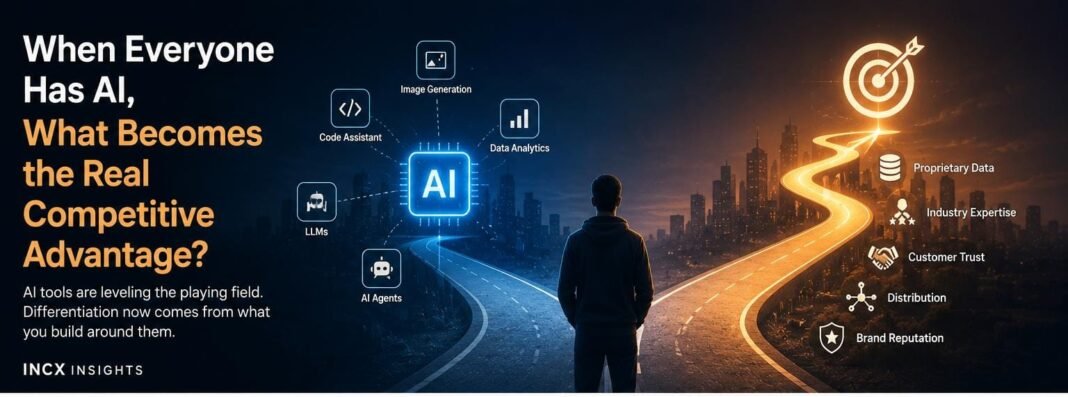
For decades, technology itself could be a startup’s competitive advantage. Building sophisticated software required skilled engineers, significant capital, computing infrastructure and years of technical expertise. Companies that could assemble those resources gained an advantage that competitors could not easily reproduce. Artificial intelligence is changing that equation. A small team can now use large language models, coding assistants, image-generation tools, analytics platforms and AI agents to perform work that once required much larger teams. A founder can test an idea, build a prototype, analyse customer feedback, create marketing material and automate parts of the business without having to build every technological capability from scratch. That is an extraordinary opportunity, but it creates a difficult question for entrepreneurs: what happens when everyone has access to roughly the same technology? The answer may be that AI itself becomes less important as a competitive advantage. The real advantage will increasingly come from what a company builds around AI—and what it develops that competitors cannot easily copy.
AI Is Becoming Startup Infrastructure

AI is rapidly moving from an experimental technology to part of the basic infrastructure of modern startups. Founders are using it across product development, customer support, research, marketing and internal operations rather than treating it as a feature added to an existing product. The scale of investment and adoption reflects how quickly this shift is happening. Generative AI has become one of the fastest-adopted technologies in history, while businesses are increasingly integrating AI into everyday operations. Startups are responding to the same change. AI-native companies are being built with smaller teams, faster development cycles and increasingly ambitious business models. This helps explain the excitement surrounding AI startups, but it also reveals the central challenge. The tools that allow one startup to build faster are increasingly available to its competitors as well. AI may therefore make it easier to start a company while making it harder to differentiate one.
When Building Becomes Easier, Differentiation Becomes Harder

The traditional technology startup had a natural barrier to entry. Building a complex product required money, technical talent, infrastructure and time. Those constraints limited the number of companies capable of competing. AI weakens some of those barriers. Two founders working on opposite sides of the world can access similar models, coding tools and development infrastructure. They can turn an idea into a functioning prototype far faster than founders could a few years ago. That creates a paradox: AI lowers the barrier to entrepreneurship while raising the bar for differentiation. If one startup can build an AI chatbot, another probably can too. If one company automates content creation, competitors can offer similar capabilities. If an AI-powered workflow becomes popular, the underlying feature may eventually be incorporated into another platform or even into the model provider itself. The competitive advantage therefore moves somewhere else. It may come from proprietary data, customer relationships, distribution, industry expertise, brand reputation, specialised workflows or a deep understanding of a particular problem. The question is no longer simply, “Can we build this?” It is becoming, “Why would customers choose us when someone else can build something similar?”
The Problem with Building Only on AI
This is where the idea of the “AI wrapper” becomes important. There is nothing inherently wrong with building a product around an existing AI model. Much of software innovation has always involved combining existing technologies in useful ways. The problem arises when the entire competitive advantage of a company depends on a feature that the underlying AI provider can easily reproduce. A basic writing assistant can be copied. A generic chatbot can be copied. A simple summarisation tool can be copied. If the model provider eventually offers the same capability directly, the startup may find itself competing with the company supplying its core technology. That does not mean AI application startups have no future. It means the visible AI feature may be only one layer of the business. The stronger moat is often built around it: proprietary information, specialised workflows, customer trust, distribution, domain expertise and deep integration into the customer’s existing operations. The easiest part of a product to copy is often the weakest part of its competitive advantage.
The Model May Not Be the Moat
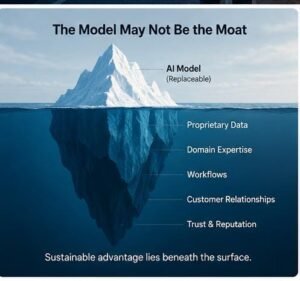
The early AI race was dominated by questions about models. Which model is smartest? Which is fastest? Which is cheapest? Which company has the largest model? Those questions still matter, but for many startups, the model itself may increasingly become a replaceable component. Consider an AI company serving the insurance industry. Its advantage does not necessarily come from having access to one particular language model. A competitor may be able to access a similar model. The stronger advantage could come from years of claims data, specialized insurance workflows, relationships with insurers and knowledge of regulatory requirements. The model is the engine, but the business is the vehicle. Customers are not buying the engine. They are buying the outcome. That distinction is likely to become increasingly important as foundation models become more accessible and interchangeable. A startup that depends entirely on having access to a particular model may find its advantage disappearing as soon as better or cheaper alternatives become available.
Distribution Could Beat Technology
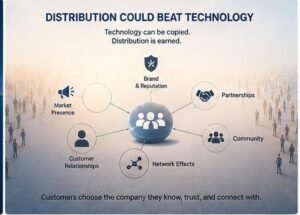
There is another resource AI cannot simply manufacture overnight: distribution. A competitor can reproduce a feature, but it cannot instantly reproduce a loyal customer base, a trusted reputation, strategic partnerships or a community built over years. Imagine a market with hundreds of AI products that perform roughly the same task. Most customers will not have the time or expertise to compare every model, benchmark and technical specification. They may choose the product they already know. They may follow a recommendation from someone they trust. Or they may choose the product that fits most naturally into the workflow they already use. This makes distribution increasingly valuable. When technology becomes abundant, attention becomes scarce. And when convincing customers becomes easier for everyone, trust becomes even more difficult to earn. A startup with an average technology and excellent distribution may ultimately outperform a startup with exceptional technology and no reliable way to reach customers.
The Product Will Matter More Than the AI Behind It
The most important question for a startup may therefore shift from “What can AI do?” to “What problem are customers willing to pay us to solve?” A hospital does not necessarily want another AI model. It wants doctors and staff to spend less time on administrative work. A bank does not necessarily need an impressive chatbot. It needs faster processes, better customer service and stronger fraud detection. A law firm does not care how sophisticated an AI system sounds if it does not help lawyers research cases, review documents or work more efficiently. Customers ultimately pay for outcomes, not algorithms. The AI may be invisible to the customer. What matters is whether the product saves time, reduces costs, increases revenue, improves accuracy or makes an existing process dramatically easier. That is why the strongest AI startups may not look like “AI companies” to their customers at all. They may simply look like excellent businesses that happen to use AI exceptionally well.
AI-Native Companies Are Changing the Meaning of a Startup
The more interesting AI businesses may not be traditional software companies with an AI feature added to an existing product. They may be companies that rethink how an entire workflow is performed. Mercor provides an interesting example. The company built an AI-driven recruitment platform around candidate assessment, matching and hiring workflows, and its business has expanded into connecting AI companies with specialized human experts who help train and evaluate AI systems. Its rapid rise and multibillion-dollar valuation demonstrate investor interest in companies that use AI to reshape established workflows rather than simply adding an AI feature to existing software. What makes the example interesting is not simply the use of AI. It is the way the company sits between AI systems and the human expertise those systems still require. That illustrates a broader opportunity. Instead of building another tool that helps an employee perform one task faster, startups can ask whether AI makes it possible to redesign the entire workflow. The opportunity is not always better software for the same process. Sometimes it is a fundamentally different process.
The New Competitive Advantage Could Be Learning Speed
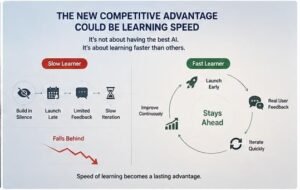
When startups can build products faster, being first to launch becomes less meaningful. The more important question may be: who learns faster after launch? Imagine two startups entering the same market with similar products. One spends six months refining its product before showing it to customers. The other launches a basic version within a few weeks and begins learning immediately. The second company watches where users struggle. It studies which features people actually use. It listens to complaints, measures behavior and changes the product repeatedly. A year later, the second company may have a much stronger business, not because its original product was better, but because it has accumulated something competitors cannot simply download: knowledge about its customers. AI can accelerate this learning process by analyzing customer conversations, identifying recurring problems and finding patterns across large amounts of feedback. But AI cannot decide what those discoveries actually mean. Someone still has to interpret the evidence, challenge assumptions and decide what the company should do next. In a world where products can be built quickly, the ability to learn may become more valuable than the ability to build quickly.
Human Judgment Becomes More Valuable When AI Becomes Common
As AI becomes part of everyday business, there is a temptation to assume that better AI automatically produces better decisions. It does not. A company can use AI to identify market trends and still misunderstand its customers. It can automate marketing and still target the wrong audience. It can build an impressive product and discover that nobody wants to pay for it. The problem is not always a lack of information. Sometimes it is a failure to decide which information matters. When every founder can ask an AI system to generate market research, business ideas and strategic recommendations, information becomes less scarce. Judgment becomes more valuable. Founders will need to recognise meaningful signals, question convenient answers and understand when the data is pointing in the wrong direction. In an AI-saturated market, knowing what not to build may become just as valuable as knowing what AI can build.
Trust Could Become the Ultimate Moat

AI is creating an abundance of information and content. But abundance can create another problem: how do people know what to trust? Customers can encounter dozens of companies producing polished AI-generated content. Businesses can automate advertisements, product descriptions, recommendations and customer communication. As these outputs become increasingly similar, sounding professional stops being a meaningful advantage. Trust fills the gap. A company that consistently delivers what it promises, protects customer information, communicates honestly and takes responsibility when something goes wrong can develop an advantage that cannot be generated with a prompt. Reputation takes years to build and can disappear quickly. This matters particularly in industries where mistakes are expensive. Someone choosing a healthcare service, financial product, legal solution or educational platform may care less about whether the company uses the newest AI model and more about whether they believe the company will stand behind its decisions. As AI becomes better at producing answers, businesses may increasingly compete on something AI cannot manufacture overnight: credibility.
India Could Be One of the Biggest Beneficiaries
This shift could be particularly interesting for Indian startups. AI lowers some of the costs associated with experimentation, development and automation, giving smaller teams more room to build products for large and complex markets. But India’s biggest opportunity may not be another general-purpose AI assistant. It may be AI combined with local knowledge. India has enormous markets where language, regulation, infrastructure and customer behavior create problems that cannot be solved simply by plugging a generic model into an interface. Consider a startup building tools for small manufacturers. Its advantage might come from understanding local supply chains, procurement practices and compliance requirements. A financial technology company could build AI systems designed around the realities of India’s diverse customer base and financial ecosystem. An education startup could develop tools that work across multiple Indian languages rather than assuming that every learner interacts with technology in English. These businesses would not necessarily win because they have a better AI model. They could win because they understand a specific problem better than a generic global competitor. The crowded idea is “AI for everyone.” The more interesting opportunity is “AI for this customer, solving this specific problem.”
The Startup Race Is Changing
AI is not removing competition from entrepreneurship. It is changing what companies have to compete on. Technology still matters, but access to technology is becoming less exclusive. As more founders gain access to powerful models, coding tools and automation platforms, the things surrounding the technology become increasingly important. Customer relationships, proprietary data, distribution, industry knowledge, brand, trust, workflow integration and organizational learning are all becoming more valuable because they take time to build and are harder to reproduce. This creates an important paradox. AI makes entrepreneurship easier to enter but potentially harder to win. More people can build products, which means customers have more choices. More choices mean greater competition for attention, trust and loyalty. The startup question therefore has to evolve. It is no longer enough to ask, “Can we build it?” The better question is, “Can we build something customers will choose, trust and continue using when competitors have access to the same technology?”
So, What Happens When Every Startup Has the Same AI Tools?

AI is lowering the cost of building software. It is accelerating experimentation and allowing smaller teams to accomplish more with fewer resources. But technology alone does not create a durable company. If everyone has access to similar AI capabilities, the scarce resources move elsewhere. They move into customer relationships, proprietary knowledge, distribution, trust, specialized expertise and the organizational ability to learn. The winning startup may not be the one with the most sophisticated AI. It may be the one that understands its customer best, learns fastest and turns widely available technology into something people genuinely cannot imagine working without. When everyone can build, the real competitive advantage may be knowing what is worth building—and building something others cannot easily replace.