

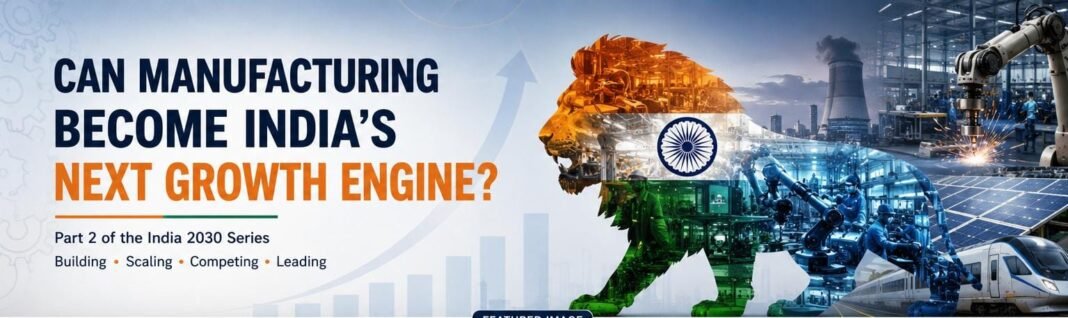

Part 2 of the India 2030 Series
In the first article of the India 2030 series, we looked at what the next phase of India’s growth could look like and the forces that could shape the country by the end of this decade. But growth does not happen on its own. It needs industries capable of creating jobs, generating exports, attracting investment and improving productivity. One of the biggest questions for India’s next phase of development is whether manufacturing can become one of those engines of growth.
For decades, services have been one of the strongest pillars of the Indian economy. Information technology, financial services, telecommunications and business services have helped India establish a strong position in the global economy. Yet manufacturing offers something different. It can connect investment with employment, domestic demand with exports, and technological development with large-scale production. This makes manufacturing particularly important for a country like India, where millions of people will continue to enter the workforce over the coming years.
The question, therefore, is not whether manufacturing is important for India. It is whether India can build a manufacturing ecosystem large, productive and technologically advanced enough to become a major driver of growth by 2030.
India’s Manufacturing Opportunity

Manufacturing has historically contributed roughly 15–17% of India’s GDP, according to NITI Aayog. That remains considerably lower than the role manufacturing has played in countries that experienced large-scale industrial transformations. NITI Aayog’s recent manufacturing roadmap argues that increasing manufacturing’s contribution towards 25% of GDP would be important for India’s ambition to become a global manufacturing leader. NITI Aayog’s manufacturing roadmap
The opportunity is significant because manufacturing has effects that extend far beyond factories. A large manufacturing plant creates demand for suppliers, logistics companies, warehouses, packaging businesses, engineering services, maintenance, finance and transportation. When these connections develop across an industrial cluster, one investment can generate activity across an entire ecosystem.
Manufacturing can also help India diversify its exports. Instead of depending primarily on services and traditional goods, India can increasingly export finished products, components and sophisticated technologies. This becomes particularly important as global companies rethink their supply chains and look for additional manufacturing locations.
India has the advantage of a large domestic market, a sizeable workforce and an increasingly sophisticated digital and physical infrastructure. The challenge is converting these advantages into globally competitive manufacturing capabilities.
From Importing to Manufacturing
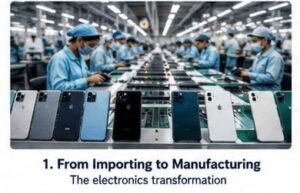
One of the clearest examples of India’s manufacturing transformation can be seen in electronics.
A decade ago, India was heavily dependent on imported mobile phones. Today, it has become one of the world’s largest mobile-phone manufacturing and exporting bases. According to government data, electronics production increased from around ₹1.9 lakh crore in 2014–15 to approximately ₹12 lakh crore in 2024–25. Mobile-phone production increased from roughly ₹18,000 crore to ₹5.45 lakh crore over the same period, while mobile-phone exports rose from about ₹1,500 crore to approximately ₹2 lakh crore. Government data on India’s electronics manufacturing growth
The transformation continued into 2025–26. Government estimates released in July 2026 put electronics production at ₹13.11 lakh crore, with electronics exports reaching ₹4.24 lakh crore. Mobile-phone production was estimated at ₹6.27 lakh crore, while mobile-phone exports reached approximately ₹2.60 lakh crore. Government update on electronics manufacturing, July 2026
These numbers are important because they demonstrate that India’s manufacturing story is no longer limited to policy announcements. Production capacity has actually expanded, companies have invested, and exports have grown.But this success also raises the next question: how much value is India actually capturing?
The Apple Effect and the Rise of Global Manufacturing

Apple’s expanding manufacturing presence in India provides another useful example. Apple’s exports from India crossed ₹1 lakh crore in 2024, reaching approximately ₹1,10,989 crore, according to government data. Government data on Apple’s manufacturing and exports from India
The importance of Apple’s presence goes beyond the number of iPhones assembled in India. Large global manufacturers can create ecosystems around themselves. Suppliers, component manufacturers, logistics companies, testing facilities, packaging firms and other service providers can all benefit when production expands. This is how manufacturing can gradually move from individual factories to industrial ecosystems.
However, assembly is only the beginning. If India wants to capture a much larger share of the economic value generated by global manufacturing, it needs to move further into components, design, engineering, research and development, industrial machinery and technology. Producing a smartphone in India is valuable. Producing the components, designing the technology and developing the machinery used to manufacture that smartphone in India would create substantially more value.
That is the next stage of the manufacturing challenge.
Can PLI Change the Manufacturing Landscape?
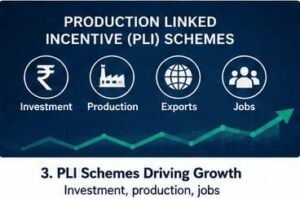
The Production Linked Incentive scheme has become one of the central pillars of India’s manufacturing strategy. Introduced across 14 strategic sectors, the programme aims to encourage investment, increase production, improve exports and create employment.
Government data released in 2026 shows the scale of the programme. By March 31, 2026, PLI schemes had attracted more than ₹2.40 lakh crore in actual investment, while production or sales associated with the schemes had crossed ₹20 lakh crore and exports had exceeded ₹15 lakh crore. Employment generated under the schemes had also crossed the 14-lakh mark. Government update on PLI schemes, 2026
The sectors covered by the programme include electronics, automobiles and auto components, pharmaceuticals, medical devices, telecommunications, solar photovoltaic modules, batteries, textiles, food processing and specialty steel. Government overview of PLI schemes
PLI has demonstrated that government incentives can influence investment decisions and help industries reach scale more quickly. But incentives alone cannot build a globally competitive manufacturing economy. Once incentives become less important, companies will still need reliable infrastructure, skilled workers, efficient logistics, advanced technology and competitive costs.
The real measure of PLI’s success will therefore not simply be how much investment it attracts during the incentive period. It will be whether the industries created around these investments remain competitive after the incentives become less significant.
India Needs to Move Up the Value Chain
This is perhaps the most important challenge facing India’s manufacturing ambitions. India does not simply need more factories. It needs more productive factories producing higher-value goods. The electronics sector illustrates this perfectly. India has made major progress in assembling smartphones, but the deeper opportunity lies in developing domestic capabilities in components, semiconductor-related industries, materials, machinery, design and research.
Government estimates suggest that domestic value addition in electronics has been increasing as component ecosystems develop. Yet India still imports many important components and inputs used in electronics manufacturing. Government data on electronics value addition and manufacturing
Moving up the value chain means gradually shifting from “Made in India” to a more ambitious model: products that are increasingly designed, engineered, developed and manufactured in India.
This distinction will matter enormously by 2030.
Manufacturing Is Bigger Than Electronics
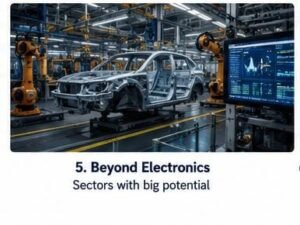
Electronics may be one of India’s most visible manufacturing success stories, but the opportunity extends across many sectors. India already has significant capabilities in automobiles, pharmaceuticals, textiles, chemicals and food processing. Electric vehicles and battery manufacturing are creating new industrial opportunities, while defence manufacturing is receiving greater attention as India seeks to develop domestic capabilities and reduce dependence on imports.
The Production Linked Incentive programme itself reflects this diversity. Its coverage across automobiles, pharmaceuticals, telecommunications, solar modules, textiles, batteries and other sectors shows that India’s manufacturing strategy is not centered around one industry. Government overview of PLI sectors
The bigger opportunity is to build interconnected manufacturing ecosystems where large companies, MSMEs, suppliers, logistics providers, technology firms and research institutions operate together. That is how manufacturing becomes an economic engine rather than simply a collection of factories.
The Scale Problem
One of India’s long-standing manufacturing challenges is scale.India has millions of small and medium-sized enterprises, but relatively few companies have grown into large global manufacturers. NITI Aayog has previously identified the inability of Indian firms to achieve scale as one of the structural challenges limiting manufacturing competitiveness. NITI Aayog on India’s scale challenge
Scale matters because manufacturing economics often reward companies that can produce in very large volumes. Higher production can lower per-unit costs, justify investment in automation, attract specialized suppliers and make it easier to compete in international markets. India therefore needs not only more MSMEs, but more MSMEs capable of becoming larger and more productive enterprises. That requires easier access to finance, better technology, improved infrastructure, skilled workers and stronger connections with domestic and international markets.
Infrastructure Could Decide the Outcome
A manufacturing economy cannot be built with factories alone. It needs efficient ports, highways, railways, warehouses, industrial parks, reliable electricity and fast logistics. It also needs efficient customs systems and predictable regulations.
For a company deciding between manufacturing in India, Vietnam, Mexico or another emerging production hub, the final decision is not determined only by wages. The total cost of production also includes transportation, energy, delays, inventory, compliance and the time required to move products from a factory to a customer. India has made major investments in infrastructure and logistics in recent years, but the next phase will be about making the entire system work together more efficiently. The objective should not simply be to build more infrastructure. It should be to make Indian manufacturing faster, cheaper and more predictable.
The Jobs Question

Manufacturing matters to India for another reason: employment.
India has a large working-age population, and millions of young people will continue to enter the labour market. Not everyone will work in software, finance or other highly skilled service industries. India therefore needs sectors capable of creating employment across a wide range of skill levels.
Manufacturing can provide that bridge.
A modern factory can employ machine operators, technicians, quality-control specialists, engineers, supervisors and managers. Around the factory, logistics companies, suppliers, maintenance businesses and other services can create additional employment.
The electronics industry provides an interesting example. Government estimates released in 2026 suggest that electronics manufacturing has created around 25 lakh jobs over the past decade, with women accounting for a large share of the direct workforce in mobile-phone manufacturing. Government data on employment in electronics manufacturing
For India, however, the objective cannot simply be to create large numbers of jobs. The bigger goal should be to make those jobs increasingly productive and better paid as workers gain skills and industries move toward higher-value production.
India Is Competing with the World
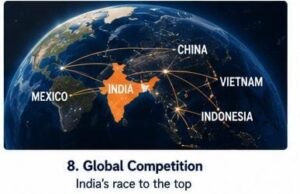
India’s manufacturing opportunity exists within a highly competitive global environment. China remains the world’s dominant manufacturing power. Vietnam has developed a strong electronics manufacturing ecosystem. Mexico has benefited from supply-chain shifts connected to the United States. Indonesia is building capabilities in electric vehicles and batteries. India is therefore competing not only with its own past but with countries that are actively trying to capture the next generation of global manufacturing. This means low labour costs alone will not be enough. India’s long-term competitive advantage will need to combine scale, skilled workers, technology, infrastructure, market access, reliable energy and innovation.
NITI Aayog’s recent manufacturing roadmap reflects this shift by placing greater emphasis on advanced manufacturing and technologies such as artificial intelligence, robotics, automation and other frontier technologies. NITI Aayog’s manufacturing roadmap
The factory of 2030 is unlikely to resemble the factory of 2000.
The Factory of 2030 Will Be Different
Artificial intelligence, robotics, industrial IoT, digital twins, advanced materials and automated quality control are changing how products are designed and manufactured.This creates both an opportunity and a challenge for India.
The opportunity is that India can build advanced manufacturing capabilities while its industrial ecosystem is still expanding. Instead of repeating older models of industrialization, Indian companies can potentially adopt newer technologies from the beginning.The challenge is that automation can reduce the demand for certain low-skilled jobs.This means India’s manufacturing strategy cannot focus only on attracting factories. It must also focus on developing workers who can operate, maintain and improve increasingly automated production systems.
The manufacturing workforce of 2030 will need to understand machines, software, data and increasingly AI-powered production systems.
So, Can Manufacturing Become India’s Next Growth Engine?
The answer is yes—but it will not happen automatically.India has already demonstrated that rapid manufacturing transformation is possible. The growth of electronics production, the expansion of mobile-phone exports, the arrival of major global manufacturers and the investment generated through PLI schemes all point towards a manufacturing ecosystem that is becoming more ambitious.
But the next stage will be harder.
India will need to move from assembly to deeper domestic value addition, from incentives to productivity, from small-scale production to global scale and from importing technology to developing more of its own.The goal should not be to become merely a low-cost factory for the world.
It should be to become a country capable of designing, developing, manufacturing and exporting increasingly sophisticated products at global scale.That is a much bigger ambition.
What Manufacturing Could Mean for India by 2030
If India succeeds, the impact will extend far beyond factories.A stronger manufacturing sector could create millions of employment opportunities, increase exports, strengthen MSMEs, attract foreign investment and generate demand for logistics, engineering, research and technology. It could also make India more resilient in strategically important sectors such as electronics, pharmaceuticals, defence, energy technologies and critical components.
More importantly, manufacturing could connect several of the themes introduced in the first article of this India 2030 series. Economic growth, employment, technology, exports and global competitiveness are not separate stories. They can reinforce one another through a strong industrial base.But India cannot manufacture its way into the future simply by producing more of what it already produces.
The real opportunity lies in producing better, more complex and more valuable products, while capturing a larger share of the value created.
The Bigger India 2030 Question
Ultimately, the manufacturing story is not really about factories. It is about the kind of economy India wants to become.Can India remain primarily a large consumer market with a powerful services sector? Or can it become a country that is simultaneously a major consumer, a services powerhouse, a manufacturing hub, a technology developer and a global exporter?Manufacturing does not necessarily have to replace services as India’s growth engine. In fact, India’s greatest advantage may come from combining the two.
Software can make factories smarter. AI can improve production. Digital infrastructure can connect businesses. Financial services can support investment. Logistics can connect Indian factories with global customers. Skilled workers can move between manufacturing and technology-intensive industries.The manufacturing opportunity for India, therefore, is not about returning to an old industrial model.It is about building a new kind of industrial economy—one in which manufacturing and services grow together.If India can achieve that at scale, manufacturing could become one of the defining engines of the country’s next phase of growth.And that brings us to the next question in the India 2030 series:
What happens when artificial intelligence begins to transform not just India’s technology sector, but the way the entire economy works?