

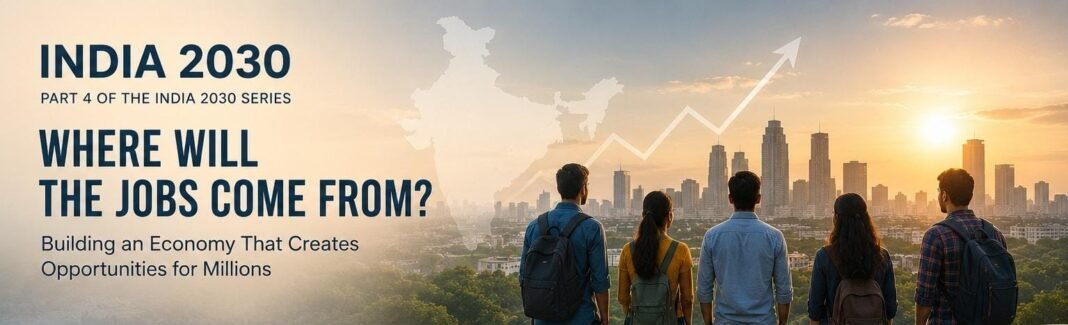

Part 4 of the India 2030 Series
In the first article of the India 2030 series, we asked what India’s next phase of growth could look like. The second explored whether manufacturing could become one of the country’s next major growth engines. The third looked at artificial intelligence and how it could transform everything from factories and businesses to healthcare and education.But there is a question underneath all of these changes that may ultimately matter more than GDP numbers, technological breakthroughs or new factories.
Where will the jobs come from?
India is entering the next phase of its economic development with one of the world’s largest working-age populations. That can be an enormous advantage. A large workforce can support production, consumption, entrepreneurship and innovation. But a young population does not automatically create a demographic dividend.
People need productive work.If India can create enough productive and increasingly higher-value jobs, its workforce could become one of the country’s greatest economic advantages. If it cannot, the same demographic structure could become a source of economic and social pressure.That makes employment one of the most important questions of India’s 2030 story.
India’s Demographic Advantage Is a Window, Not a Guarantee

India’s working-age population gives the country an opportunity that many ageing economies do not have. The World Economic Forum’s Future of Jobs Report 2025 puts India’s working-age population at about 672.8 million and identifies demographic change, technology and the green transition among the major forces reshaping the country’s labour market through 2030. But demographics alone cannot create prosperity.
A country can have millions of young people and still struggle with unemployment, underemployment, low wages or poor-quality work. The real demographic dividend occurs when a growing working-age population is accompanied by education, skills, investment, productivity and sufficient demand for labour.India has made progress on several of these fronts. NITI Aayog reports that India’s labour-force participation rate for people aged 15–59 increased from 53.6% in 2018–19 to 61.6% in 2022–23, while the unemployment rate for the same age group declined from 6.2% to 3.4% over that period.
The latest Periodic Labour Force Survey also provides a much more detailed picture of India’s employment structure. The PLFS has become the country’s primary source for labour-force participation, employment and unemployment statistics, and its methodology was expanded from 2025 to provide more frequent labour-market information.These improvements matter, but they do not answer the bigger question.
Are enough of these jobs productive enough to raise living standards rapidly?
That is where India’s real challenge begins.
India Does Not Have One Labour Market
It is tempting to talk about “India’s jobs” as though every worker faces the same reality.
They do not.
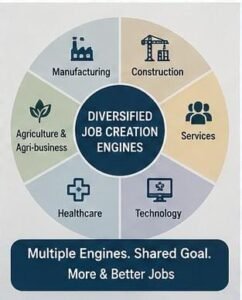
A software engineer in Bengaluru, a textile worker in Surat, a farmer in Bihar, a delivery worker in Delhi, a small shop owner in Rajasthan and a young graduate searching for their first job are all part of the same economy, but their employment opportunities are very different.India’s workforce is spread across agriculture, manufacturing, construction, trade, transport and services. The latest PLFS data continues to show this diversity, with agriculture employing a very large share of workers while manufacturing, construction, trade and services account for substantial portions of non-agricultural employment.This creates an important challenge for policymakers.India cannot solve its employment problem with one sector.It needs several engines operating at the same time.
Manufacturing can absorb workers into factories and supply chains. Construction can create employment while building infrastructure. Tourism can create jobs in hospitality, transportation and local services. Healthcare and education can expand as incomes rise. Technology can generate high-value employment. Agriculture can become more productive while creating opportunities in food processing, logistics and agribusiness.The India 2030 employment story will therefore be about diversification.
Manufacturing Can Create Jobs, But It Cannot Do Everything
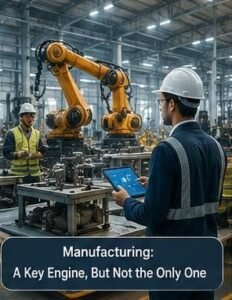
This is where the previous article in the series becomes important.Manufacturing has long been viewed as one of India’s best opportunities for creating large numbers of productive, non-farm jobs.A manufacturing ecosystem can employ workers directly in factories while creating additional employment in logistics, maintenance, packaging, transportation, warehousing and supplier companies.
The recent growth of electronics manufacturing illustrates this possibility. India’s mobile-phone manufacturing ecosystem has expanded dramatically over the past decade, and government data indicates that electronics manufacturing has generated around 25 lakh jobs over the last decade.But manufacturing itself is changing.Modern factories increasingly use automation, robotics, artificial intelligence and sophisticated machinery. That means future manufacturing growth may not create jobs in exactly the same way as earlier industrialisation did.
India therefore needs a manufacturing strategy that combines automation with employment-intensive sectors such as textiles, food processing, footwear, furniture, tourism-linked manufacturing and other industries where labour can remain an important part of the production process.The objective should not be to choose between machines and people.It should be to make workers more productive with machines.
Services Will Remain Central to India’s Jobs Story
India’s employment future cannot be understood without services.The country has already developed internationally competitive industries in IT, business services, finance and telecommunications. But the next wave of service-sector employment could be much broader. Healthcare, education, tourism, logistics, financial services, retail, professional services and digital commerce can all create employment as India’s economy expands.
Consider healthcare. As incomes rise and India’s population ages gradually, demand for healthcare services is likely to increase. That means more doctors and nurses, but also laboratory technicians, healthcare administrators, medical equipment specialists, digital-health professionals and home-care workers.
Tourism provides another example. India’s cultural heritage, natural landscapes and growing middle class create opportunities for hotels, restaurants, travel companies, transportation providers, guides, local artisans and digital travel businesses. These are not necessarily jobs that appear in discussions about India’s technology future. But they could employ millions of people.
The Gig Economy Is Already Changing Work
Another major part of India’s employment story is the rise of platform and gig work. Delivery platforms, ride-hailing services, online marketplaces and digital freelancing have created new ways for people to earn income. For a young person who cannot immediately find a conventional salaried job, platform work can provide a relatively accessible entry point into the labour market. But it also raises questions about job quality, income stability, social security and long-term career progression.
This distinction will become increasingly important by 2030.India cannot measure employment success only by asking whether someone is “working”. It also needs to ask whether people have stable incomes, opportunities to develop skills, access to social protection and a realistic path toward higher productivity and better earnings. The future of work will therefore require a broader definition of what constitutes a good job.
AI Will Change Jobs, Not Just Eliminate Them
The previous article in this series explored India’s AI opportunity. Now the employment implications become unavoidable. The World Economic Forum’s Future of Jobs Report 2025 estimates that globally, macroeconomic and technological changes could create around 170 million jobs while displacing approximately 92 million by 2030, resulting in a net increase of about 78 million jobs. AI and information-processing technologies alone are expected to both create and displace millions of jobs.
The lesson for India is important. The future is unlikely to be a simple story of “AI takes jobs”. Instead, many jobs will change.
A financial analyst may use AI to process data faster. A designer may use generative tools to produce initial concepts. A lawyer may use AI to review documents. A doctor may use AI-assisted systems to analyse medical images. A factory technician may work alongside automated machinery. The human role does not necessarily disappear. But the tasks within the role can change significantly.
This means the most important skill of the 2030 workforce may not be knowing one particular software programme. It may be the ability to learn continuously as technology changes.
India’s Biggest Employment Challenge May Be Skills

This is where India’s demographic advantage becomes a skills challenge. The World Economic Forum estimates that around 63% of India’s workforce will require training by 2030. It also estimates that around 12% of the workforce may be unlikely to receive the necessary upskilling, equivalent to more than 70 million workers.
That is an enormous number, and it tells us something important about India’s employment future. Creating jobs is only half the problem. India also needs workers who are prepared for those jobs. The jobs growing fastest may increasingly require skills in AI, data, cybersecurity, software, advanced manufacturing, renewable energy and digital technologies. The World Economic Forum identifies Big Data Specialists, AI and Machine Learning Specialists and Security Management Specialists among India’s fastest-growing job roles towards 2030.
At the same time, India will still need electricians, technicians, nurses, teachers, construction workers, mechanics, hospitality workers and skilled tradespeople. The future workforce will therefore require both advanced digital skills and strong vocational skills.
Degrees Alone May Not Be Enough
India has traditionally placed enormous importance on formal educational qualifications. A degree has often been treated as the basic ticket into the professional workforce. But employers are increasingly looking at what people can actually do. The World Economic Forum reports that 30% of companies operating in India expect removing degree requirements for certain roles and moving toward skills-based hiring to be an effective way of improving access to talent, compared with 19% globally.
This could become a major shift. A person who can demonstrate that they can analyse data, operate advanced machinery, manage digital systems, use AI tools or solve a specific business problem may increasingly compete with someone whose advantage is simply holding a particular degree.
That does not make universities irrelevant. It means the relationship between education and employment needs to change. Education should provide foundations. Skills programmes should provide practical capabilities. Employers should provide opportunities to apply those skills. The boundaries between education and employment may become much more fluid by 2030.
India’s Women Could Be a Major Untapped Workforce
There is another part of the employment story that India cannot afford to ignore: women. Increasing women’s participation in the workforce could significantly expand India’s productive capacity. The opportunity is particularly important because women are often constrained not by a lack of ability but by factors such as unpaid care responsibilities, safety concerns, mobility, lack of suitable workplaces and limited access to flexible employment.
Technology could change some of these constraints. Remote work, digital platforms, flexible employment and entrepreneurship can create new opportunities for women who may otherwise struggle to enter conventional workplaces. Manufacturing can also play a role. India’s expanding electronics manufacturing sector provides an example of an industry where women form a substantial share of the direct workforce. But increasing participation requires more than creating jobs.
Transport, childcare, workplace safety, flexible work arrangements and social norms all influence whether women can remain in employment. A serious India 2030 employment strategy therefore has to treat women’s workforce participation as an economic issue, not simply a social one.
The Green Economy Could Create a New Class of Jobs
India’s employment story will also be shaped by the energy transition.
As India expands renewable energy, electric mobility, battery manufacturing, energy-efficient buildings and climate-related infrastructure, new occupations will emerge. Solar technicians, battery specialists, EV service professionals, environmental engineers, energy auditors and renewable-energy technicians are examples of roles that could grow as the economy changes. The World Economic Forum identifies renewable-energy engineers, environmental engineers and electric/autonomous vehicle specialists among the fastest-growing global job categories towards 2030.
For India, the green transition therefore represents both an environmental challenge and an employment opportunity. The country could potentially create jobs while simultaneously building the infrastructure required for a lower-carbon economy.
The Small Business Question
Large corporations often dominate conversations about employment, but India’s MSMEs may be even more important for the everyday labour market. Small businesses employ people across manufacturing, retail, hospitality, transport, services and local industries. The challenge is that many small businesses remain low-productivity enterprises. A small shop using digital payments is more connected than it was a decade ago. A small manufacturer using cloud software can potentially manage inventory more efficiently. A local service provider can reach customers through digital platforms.
The next step is to help these businesses use technology not simply to become digital, but to become more productive and scalable. If millions of small businesses become slightly more productive, the cumulative economic impact could be enormous. India’s employment strategy therefore cannot focus only on attracting multinational companies. It also needs to help the millions of existing businesses grow.
What Happens If India Cannot Create Enough Productive Jobs?
This is the uncomfortable part of the conversation. A large young population is often described as India’s greatest advantage. But a demographic dividend is not automatic.
If young people cannot find productive employment, they may remain underemployed, move between unstable informal jobs or spend years searching for opportunities that match their education. That can create frustration even when headline economic growth remains strong. There is also a risk of a growing mismatch between education and employment. Millions of young people may have degrees but lack the practical skills employers require, while companies may struggle to find workers with the capabilities they need. This is why India’s 2030 employment challenge is not simply about creating “more jobs”.It is about creating the right jobs in the right places for workers with the right skills.
India’s Cities Will Become Employment Engines
As India urbanises, cities will increasingly become centres of employment.Large metropolitan areas already concentrate technology, finance, manufacturing, healthcare and professional services. But the next phase of growth could also depend on India’s tier-2 and tier-3 cities.Cities such as Ahmedabad, Jaipur, Coimbatore, Kochi, Indore, Lucknow and Bhubaneswar can become important employment centres if they develop the infrastructure, education systems and business ecosystems required to support new industries.
This could reduce some of the pressure on India’s largest cities while spreading economic opportunity across more regions.Digital connectivity makes this more possible than it was in the past.A startup does not necessarily need to be headquartered in Mumbai or Bengaluru. A small business can sell nationally through digital platforms. A professional can work remotely for a company based elsewhere.The geography of employment could therefore become more distributed by 2030.
The Real Goal Should Be Productive Employment
India’s employment debate often gets trapped between two numbers: the unemployment rate and the number of jobs created.Both matter, but neither tells the entire story.A person can be employed and still earn too little.A person can work full-time but remain trapped in a low-productivity occupation.A graduate can technically be employed while working in a role that does not use their education or skills.This is why the quality of employment matters as much as the quantity.India’s long-term objective should be to move workers gradually from low-productivity activities to higher-productivity ones.
Agriculture can become more productive through technology and better supply chains. Manufacturing can move toward higher-value production. Services can become more sophisticated. Small businesses can adopt technology. Workers can acquire new skills.The result would not simply be more employment.It would be better employment.
What Could the Indian Worker Look Like in 2030?

The typical Indian worker of 2030 may look very different from the worker of today.A factory worker may operate AI-enabled machinery. A farmer may use satellite and weather data. A teacher may work with an AI tutor. A designer may use generative tools. A small entrepreneur may sell products globally through digital platforms. A healthcare worker may use AI-assisted diagnostics.The common factor will be technology.But technology will not necessarily replace the human worker.Instead, the most successful workers may be those who combine human abilities—judgement, communication, creativity, empathy and problem-solving—with technological capabilities.That is why India’s education and skills strategy will be so important.
India’s Employment Story Will Depend on Several Engines
There is no single sector that can solve India’s employment challenge.Manufacturing can create large-scale industrial and supply-chain employment. Services can continue generating high-value jobs. Construction can absorb labour while building infrastructure. Tourism can create jobs across cities and smaller communities. Healthcare and education can expand with rising incomes. Agriculture can become more productive while generating opportunities in processing and logistics. Technology can create new high-skill industries.
The goal should be to allow these sectors to reinforce one another.A manufacturing cluster creates demand for logistics. Better logistics supports exports. Higher incomes increase demand for healthcare and education. Better education produces more skilled workers. Technology makes businesses more productive. Higher productivity supports higher wages.
That is how an employment ecosystem develops.
The Bigger India 2030 Question
India’s jobs story is ultimately not about finding a job for every young person.It is about creating an economy where people can move from one level of productivity to another.A young person should be able to enter the workforce, acquire skills, increase their productivity and gradually earn more.A small business should be able to grow from five workers to fifty.A factory worker should be able to become a technician.A technician should be able to become a supervisor.A student should be able to acquire skills that remain valuable even as technology changes.That kind of mobility is what can turn demographic potential into genuine economic progress.
India 2030: The Real Demographic Dividend
India’s young population gives the country a limited window of opportunity.The size of the workforce is an advantage today, but demographic advantages do not last forever. The opportunity must be converted into productivity before the population begins to age more significantly.The answer is therefore not simply to create millions of jobs.
- India needs millions of productive pathways.
- Pathways from education to employment.
- From informal work to formal work.
- From low-skilled work to skilled work.
- From small businesses to scalable businesses.
- From traditional industries to technology-enabled industries.
- And from today’s skills to the skills of tomorrow.
If India can build those pathways, its demographic dividend could become one of the strongest foundations of the India 2030 story.If it cannot, a young population could become an opportunity that was never fully realised.That is why the most important question is not simply:
“How many jobs will India create by 2030?”
It is:“Will India create an economy where its people can become more productive, more skilled and more prosperous?”Because ultimately, India’s 2030 growth story will not be measured only by the size of its economy.It will be measured by what that growth allows millions of Indians to do with their lives.And that leads to the next question in the India 2030 series:If India is going to have the world’s largest pool of young talent, what kind of education and skills will it need to turn that potential into an advantage?
Coming next: India 2030 — The Skills India Will Need for the Future.