

Introduction
From enterprise AI and healthcare diagnostics to data infrastructure, scientific research and AI-powered financial services, these women are helping define how India builds and deploys artificial intelligence.Artificial intelligence in India is moving beyond the chatbot phase.In 2026, the conversation is increasingly about what AI can actually do inside businesses, hospitals, financial institutions, classrooms and scientific laboratories. Indian companies are moving from experimentation toward deployment, while startups are building AI products for problems ranging from cancer screening and retail automation to data governance and financial inclusion.
Yet the people building this ecosystem are still far from representative. A March 2026 analysis by *The Economic Times* found that women founded only around 10% of Indian AI startups. The gap makes the women who are already building, leading and deploying AI even more significant.
This is not a ranking. Instead, IncXInsights highlights 15 women whose work reflects different layers of India’s emerging AI and data economy — from foundational research and enterprise technology to healthcare, fintech, retail and generative AI.
1. Irina Ghose — Anthropic
Role: Managing Director, India
Focus: Enterprise AI, AI adoption and ecosystem building
Irina Ghose represents a different side of India’s AI story: bringing frontier AI into the enterprise mainstream.In January 2026, Anthropic appointed Ghose as its Managing Director for India as the company prepared to establish i
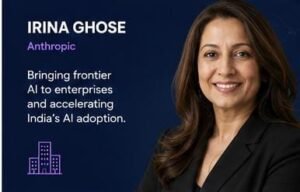
ts first Indian office in Bengaluru. She previously spent more than two decades at Microsoft India, where she led enterprise technology adoption across sectors including banking, healthcare, manufacturing and government.
Her role is particularly important as Indian businesses move from AI pilots toward larger deployments. Anthropic has also identified India as its second-largest market for Claude, with particularly strong usage in technical and mathematical work.Ghose’s work puts her at the intersection of global AI models and India’s enterprise adoption — a relationship likely to become increasingly important as companies move toward agentic and workflow-based AI.
2. Anima Anandkumar — AI Research & Accelerated Understanding
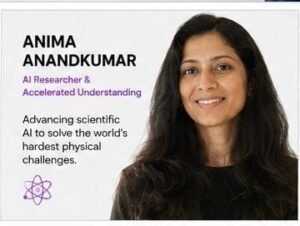
Role: AI researcher and co-founder, Accelerated Understanding
Focus: Scientific AI, physics, weather prediction and AI research
Few Indian-origin researchers have had as much influence on the scientific side of AI as Anima Anandkumar. In August 2026, Anandkumar and Benedikt Jenik launched Accelerated Understanding, a company developing AI systems designed to model physical phenomena rather than simply generate language. Its technology is aimed at areas including chip design, robotics, extreme-weather prediction and energy exploration.
Her earlier research in neural operators has helped demonstrate how AI can be used to model complex physical systems. She has also worked on AI-based weather prediction and scientific computing.Her inclusion in TIME’s 2026 list of the 100 most influential people in AI underlines how India’s contribution to AI extends beyond startups and consumer applications into fundamental research.
3. Prukalpa Sankar — Atlan
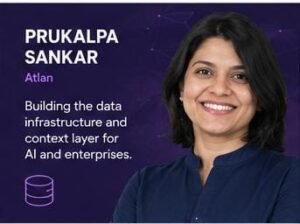
Role: Co-founder and Co-CEO, Atlan
Focus: Data infrastructure, metadata and AI context
AI systems are only as useful as the data and context surrounding them. That is the problem Prukalpa Sankar has spent years working on.Sankar is the co-founder and co-CEO of Atlan, a data and AI platform designed to help organisations discover, understand and collaborate around their data. Her company is increasingly positioning itself as a “context layer” for both human data teams and AI agents.
Before Atlan, Sankar co-founded SocialCops and worked on large-scale data projects involving governments and international organisations.Atlan’s evolution is significant because the next phase of enterprise AI will require more than powerful models. Companies need trusted data, lineage, governance and context for AI systems to produce reliable results.That makes Sankar’s work part of the infrastructure behind the AI boom rather than simply another AI application.
4. Dr. Geetha Manjunath — NIRAMAI
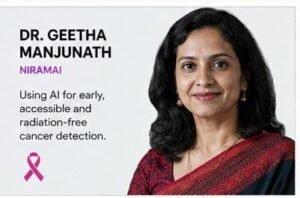
Role: Founder, CEO and CTO, NIRAMAI Health Analytix
Focus: Healthcare AI and early cancer detection
Dr. Geetha Manjunath has been building healthcare AI long before the current generative AI boom.She founded NIRAMAI Health Analytix to develop AI-powered, non-invasive and radiation-free breast cancer screening technology using thermal imaging. The company aims to improve early detection while making screening more accessible.Manjunath brings more than three decades of technology and innovation experience and previously worked in AI research at Xerox and Hewlett Packard Labs. She also holds more than 50 US patents.
In 2026, NIRAMAI showcased its technology internationally, including at VivaTech in Paris, where its AI-powered breast-health screening was presented as an example of Indian healthcare innovation.Her work demonstrates one of the most important opportunities for AI in India: applying advanced technology to large-scale healthcare problems.
5. Ashwini Asokan — Mad Street Den
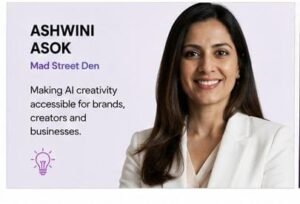
Role: Founder and CEO, Mad Street Den
Focus: Computer vision, retail AI and enterprise automation
Ashwini Asokan was building AI for retail before generative AI became a mainstream business conversation.She co-founded Mad Street Den in 2013 after working in product design and research at Intel. The company developed computer-vision technology and its Vue.ai platform for retail and commerce.
The company’s journey is particularly interesting because it shows how early Indian AI startups were already working on applied machine intelligence years before the current AI boom. A 2026 report by Mint revisited Mad Street Den’s story, describing it as one of India’s early serious AI companies and documenting the founders’ difficult decisions around its growth and financing.
Asokan’s career also highlights the importance of design in AI. Her approach has consistently focused on making AI useful inside real customer experiences rather than treating the technology as an end in itself.
6. Bindu Reddy — Abacus.AI
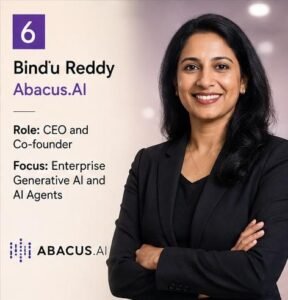
Role: CEO and Co-founder, Abacus.AI
Focus: Enterprise generative AI and AI agents
Bindu Reddy is building on the other end of the AI spectrum: enterprise-scale generative AI.She is the CEO and co-founder of Abacus.AI, a platform that provides generative AI and AI-agent capabilities to businesses. The company says its products are used by thousands of companies, including dozens of Fortune 500 organisations.Before founding Abacus.AI, Reddy served as General Manager for AI Verticals at AWS.Her journey reflects the growing shift from individual AI tools toward AI systems that can be integrated into business workflows.As enterprises increasingly experiment with autonomous agents, platforms capable of connecting models, data and business processes could become a major part of the enterprise technology stack.
7. Laina Emmanuel — BrainSightAI
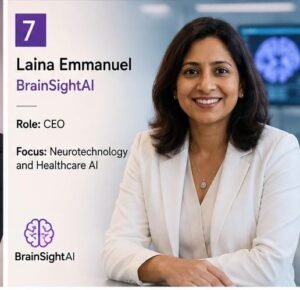
Role: CEO, BrainSightAI
Focus: Neurotechnology and healthcare AI
BrainSightAI sits at the intersection of neuroscience, healthcare and artificial intelligence.Laina Emmanuel leads the company as CEO, bringing a background in healthcare management, policy and consulting. She previously worked with organisations including the Clinton Health Access Initiative and has experience across technology and healthcare product development.
BrainSightAI develops technology designed to provide evidence-based insights for neurologists, psychiatrists and neurosurgeons.The company’s work reflects a broader trend in Indian AI: moving from generic machine-learning applications toward highly specialised systems designed around difficult scientific and clinical problems.In 2026, BrainSightAI was also recognised in India’s deeptech ecosystem, with Emmanuel highlighting the company’s work at National Startup Day.
8. Dr. Rimjhim Agrawal — BrainSightAI
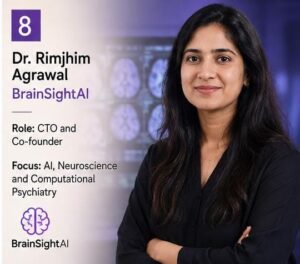
Role: CTO and Co-founder, BrainSightAI
Focus: AI, neuroscience and computational psychiatry
If Emmanuel represents the healthcare and business side of BrainSightAI, Dr. Rimjhim Agrawal represents its scientific foundation.Agrawal holds a PhD from NIMHANS focused on how AI can advance psychiatry and neurology.
Her research includes work on AI-assisted prediction and analysis of psychiatric and neurological conditions. BrainSightAI’s research portfolio also includes publications involving machine learning, schizophrenia prediction and neuroimaging.Her work illustrates an important shift in healthcare AI: the challenge is not simply building a model, but combining AI with domain-specific scientific knowledge and clinical workflows.
9. Meghna Saraogi — mirrAR

Role: Founder and CEO, mirrAR
Focus: AI, AR and retail technology
Meghna Saraogi is working on a very different AI use case: changing how consumers shop.She founded mirrAR, a technology platform combining augmented reality, AI and 3D visualisation for virtual try-ons and digital retail experiences. The company works across categories including jewellery, beauty, eyewear and fashion.
According to the company, its platform has generated more than 100,000 hours of virtual try-ons and has been associated with improvements in conversion and engagement.The significance of mirrAR lies in its application layer. Rather than treating AI as a standalone product, Saraogi’s company integrates AI-driven experiences directly into the retail journey.
10. Aarthi Subramanian — Tata Consultancy Services
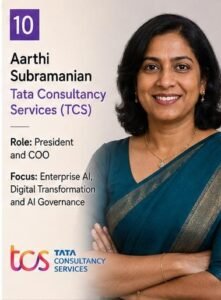
Role: President and COO, TCS
Focus: Enterprise AI, digital transformation and AI governance
AI adoption in India will not be driven only by startups. Large technology-service companies will play a major role in helping thousands of enterprises implement it.Aarthi Subramanian, President and COO of Tata Consultancy Services, is one of the prominent leaders shaping that transition.
At TCS, her focus includes emerging technologies, AI-led transformation and enterprise adoption. She has argued that companies need more than powerful AI models to generate business value.In July 2026, Subramanian highlighted AI governance, workforce transformation and new commercial models as critical issues for the next stage of enterprise AI adoption.Her position gives her influence over one of the world’s largest technology-services ecosystems — and therefore over how AI moves from experimentation into large organisations.
11. Pranjali Awasthi — Delv.AI
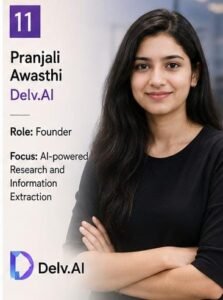
Role: Founder, Delv.AI
Focus: AI-powered research and information extraction
Pranjali Awasthi represents a much younger generation entering the AI economy. She founded Delv.AI, a platform designed to help users extract and organise information from scattered sources. Her early interest in coding and research eventually led to the creation of the startup.Her story has attracted attention partly because of her age, but the more interesting aspect is the problem Delv.AI addresses: information overload.
As AI becomes more capable, extracting useful knowledge from fragmented information is becoming an important productivity challenge for researchers, professionals and businesses.
12. Ritwika Chowdhury — unScript.ai
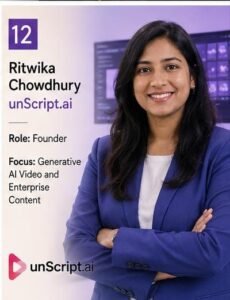
Role: Founder, unScript.ai
Focus: Generative AI video and enterprise content
Ritwika Chowdhury is building AI for one of the fastest-growing content categories: video.Her company, unScript.ai, uses generative AI to help businesses create customised video content at scale. The company has worked with enterprises including HealthifyMe, Bajaj, Max Life, Unilever and Aster DM, according to Chowdhury.
The company’s recent direction goes beyond simply generating marketing videos. It is developing an ecosystem for AI filmmakers and creators, allowing AI-assisted content to be produced, distributed and monetized. Chowdhury’s journey is an example of how India’s AI startup ecosystem is expanding beyond software infrastructure into creative industries.
13. Hardika Shah — Kinara Capital
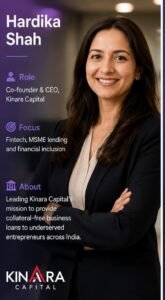
Role: Founder and CEO, Kinara Capital
Focus: AI/ML-powered lending and financial inclusion
Hardika Shah is applying AI to one of India’s oldest business problems: access to credit for small enterprises.She founded Kinara Capital, a fintech company focused on collateral-free financing for India’s MSMEs. Its lending model uses AI/ML-based data-driven credit decisioning to assess borrowers.Kinara says it has served MSMEs across multiple states and crossed $1 billion in cumulative disbursements.
This is an important example of applied AI because the value isn’t simply measured by model performance. The real question is whether technology can help financial institutions make faster and more informed decisions while reaching businesses traditionally underserved by conventional lending.
14. Neha Singh — Tracxn

Role: Co-founder and CEO, Tracxn
Focus: Data intelligence and startup analytics
AI depends on data — and India’s broader data economy needs companies capable of organising, analysing and interpreting massive amounts of information.Neha Singh co-founded Tracxn, a technology and startup intelligence platform that tracks companies, markets, funding and emerging technology trends.
Tracxn became one of India’s relatively rare B2B SaaS companies to list on the Indian stock exchanges, with Singh serving as CEO.In 2026, Tracxn’s research highlighted another important trend: roughly one in four startups founded by experienced operators in its tracked 2023–2025 cohort is focused on AI.Singh’s contribution is therefore not only as a technology entrepreneur, but also as someone helping the market understand India’s rapidly changing startup and AI landscape.
15. Vani Kola — Kalaari Capital
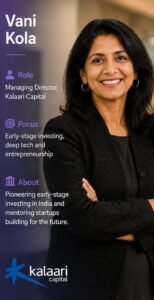
Role: Founder and Managing Director, Kalaari Capital
Focus: Venture capital, technology and India’s startup ecosystem
AI ecosystems are built by more than founders and engineers. They also depend on investors willing to fund companies before their markets are obvious.Vani Kola, founder and Managing Director of Kalaari Capital, has been one of India’s most visible technology investors for years.
Her current work increasingly intersects with emerging technology and the next generation of Indian startups. Her public writing in 2026 has also focused on developments across technology, biotechnology and AI.Her importance to the AI ecosystem lies in capital allocation. As India’s AI market matures, the investors deciding which technical ideas receive the resources to become companies can have almost as much influence on the ecosystem as the founders themselves.
Why These Women Matter to India’s AI Story
The most interesting thing about this group is that they are not all building the same kind of AI.Some are developing enterprise infrastructure. Others are working on healthcare diagnostics, financial inclusion, retail, neuroscience, scientific computing or generative video.That diversity matters.
India’s AI opportunity is unlikely to come from building only another general-purpose chatbot. The country’s strongest opportunities may emerge from applying AI to problems where India has enormous datasets, large populations, complex workflows and significant unmet demand.
Healthcare is one example. India’s digital-health infrastructure is already creating opportunities for AI-assisted screening and clinical decision-making. Recent industry analysis has pointed to applications ranging from diabetic-retinopathy screening to tuberculosis detection while also emphasising the need for stronger governance and validation.
Enterprise AI is another. Companies are increasingly moving from isolated experiments toward AI integrated into business processes, with governance, trusted data and workforce transformation becoming as important as model performance.And then there is scientific AI, where researchers such as Anima Anandkumar are demonstrating that AI can be used to model the physical world, potentially accelerating areas such as climate science, chip design and energy research.
The Bigger Picture
The rise of women in India’s AI ecosystem is still a work in progress.The numbers show a significant gap: women remain a minority among AI startup founders. But the landscape is broader than the founder count suggests.Women are increasingly visible across AI research, enterprise transformation, healthcare technology, data infrastructure, venture capital and startup leadership.
The next phase will be less about proving that women can participate in India’s AI revolution and more about ensuring they have the capital, technical opportunities, leadership positions and institutional support to shape it at scale.India’s AI story is still being written.And these women are already writing important chapters.