


Introdution
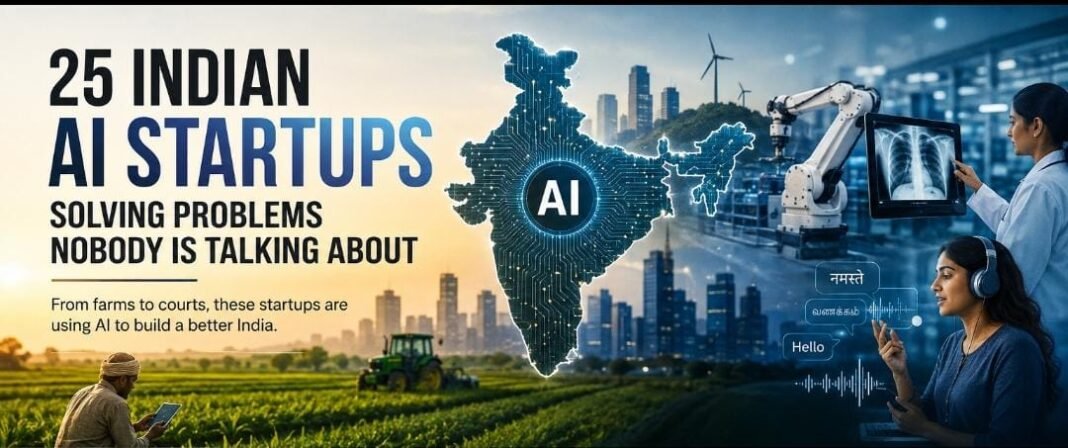
India’s AI story is moving beyond chatbots. Here are 25 startups using artificial intelligence to tackle agriculture, healthcare, factories, climate, courts, languages and the physical economy.When people talk about India’s AI boom, the conversation usually revolves around chatbots, large language models and AI assistants.But something more interesting is happening underneath the noise.
Indian startups are increasingly using AI to solve problems that are difficult, deeply local and often invisible to the average consumer. The problems range from predicting crop risks and detecting manufacturing defects to making medical diagnosis faster, digitising court workflows and helping AI understand the way Indians actually speak.
The scale of this shift is significant. A government-backed repository released at the India AI Impact Summit 2026 mapped more than 110 Indian AI startups and non-profits working across healthcare, agriculture, climate, financial inclusion, mobility and public services.
And Google’s 2026 India AI accelerator selected 20 AI-first startups from around 2,500 applications, with companies working across healthcare, climate, manufacturing, legal technology and physical-world AI.
Here are 25 companies that show what this quieter side of India’s AI ecosystem looks like.
AI That Understands India’s Farms

Agriculture is one of the clearest examples of where Indian AI is moving beyond experimentation.
Cropin is using satellite imagery, weather information, farm data and AI models to understand everything from crop health and yield to climate and supply-chain risks. In 2026, the company launched an AI-first ecosystem and later introduced OrbitAI, an agentic AI platform for food and agriculture.
Fasal is approaching farming from the field itself, combining sensors, data and predictive intelligence to help farmers make decisions around irrigation, crop health and disease.
DeHaat is tackling another difficult problem: the fragmented agricultural ecosystem. Its technology connects farmers with inputs, advisory, markets and other services, showing how AI can become useful when combined with India’s enormous rural distribution network.
The bigger opportunity is not simply “AI for farmers”. It is making an agricultural system that can predict problems before they become expensive.
AI Moving Into Factories and Physical Work

Some of India’s most interesting AI applications are happening far away from laptops.
Jidoka, part of Google’s 2026 AI accelerator, is using computer vision for automated inspection and process guidance in manufacturing. Instead of relying entirely on manual quality checks, AI can continuously examine production processes for defects and anomalies.
Proxgy combines AI, IoT and wearable technology to digitise frontline operations, bringing intelligence into workplaces where employees are dealing with physical equipment and real-world processes.
CraftifAI is working at an even deeper layer, building AI infrastructure for embedded systems, Edge AI, IoT and FPGA development.
This is important because India’s AI opportunity is not limited to software companies. Factories, warehouses, construction sites and industrial facilities are becoming part of the AI economy too.
Healthcare AI That Works Beyond the Hospital

Healthcare may be where AI’s practical value becomes easiest to understand.
Qure.ai has built AI-powered healthcare tools around medical imaging and disease detection. Its technology is being used across more than 100 countries, with applications including tuberculosis, lung disease and other clinical workflows.
Aikenist, another company selected for Google’s 2026 accelerator, is using AI to streamline radiology workflows.
Niramai has taken a different route, using AI and thermal imaging for breast-cancer screening. The idea is particularly significant in a country where access to specialised diagnostic infrastructure remains uneven.
Aignosis is another example from India’s emerging health-AI ecosystem, using AI-based screening technology for early identification of autism-related developmental concerns.
The most compelling healthcare AI may therefore not replace doctors. It may simply help them see more, sooner.
Teaching AI to Speak India’s Language

India has a language problem that most global AI products were not originally designed to solve.
Sarvam AI is building an India-focused AI stack covering speech, translation, text, document intelligence and conversational AI. Its current systems support 22 Indian languages plus English across different capabilities, while its voice models are designed to handle regional speech and code-mixed conversations.That matters because Indians rarely speak in perfectly separated linguistic boxes. A conversation might move between Hindi and English in one sentence, while a phone call may contain regional pronunciation, background noise and informal expressions.
Gnani.ai has also focused on conversational and voice AI, targeting the enormous opportunity created by voice-based interaction in India.
This is more than a translation problem. For millions of potential users, voice and vernacular AI could become the interface to digital services themselves. India’s AI Impact Startup repository identified voice AI and vernacular interfaces as important channels for reaching underserved populations.
AI for Systems India Has Struggled to Fix

Some of the biggest opportunities are hiding inside slow-moving systems.
Adalat AI, selected for Google’s 2026 accelerator, is building technology to automate manual clerical tasks and accelerate case-resolution workflows across Indian courts.
OnFinanceAI is applying AI agents to compliance, risk and audit workflows in financial institutions. Binocs is using agentic AI for commercial due diligence and strategic advisory.
Fitsol is tackling another unglamorous problem: helping enterprises track carbon, optimise logistics and manage ESG-related processes.
Aurassure is working with AI,sensors and hyperlocal climate data to help organisations understand local environmental risks.These businesses may not look as exciting as consumer AI apps. But that is exactly the point.India’s most valuable AI applications could emerge inside the systems that businesses and governments depend on every day.
The Quiet AI Revolution Is Happening in the Real World

The remaining companies in this broader ecosystem make the same point from different directions.
Detect Technologies is applying AI to industrial operations and safety. Locus has built intelligence into logistics and delivery optimisation. Shipsy is working on technology for shipment and supply-chain operations.
SuperBryn is focused on the reliability and evaluation of voice AI agents, while PotpieAI is building structured context from code, logs and workflows so AI systems can reason about software environments. Zeron is applying AI agents to cybersecurity risks across code, cloud and vendors.
Then there are companies such as FelxifyMe, which combines AI with physiotherapy and yoga therapy for chronic pain management, and Ayna, which uses AI to help fashion businesses catalogue products and get them online faster.
Pipeshift is working on infrastructure for running AI models and agents in production, while H2Loop AI is building specialised coding models for system-software engineers. TartanHQ is tackling another behind-the-scenes problem by connecting enterprise HR and payroll systems through a unified API layer.
And this is only a small window into the ecosystem.
The important story is not that India has 25 interesting AI startups. It is that AI is beginning to move into places where technology has traditionally been difficult to deploy: farms, factories, hospitals, courts, warehouses, government systems and regional-language communities.That could ultimately matter more than another chatbot.
India’s next AI winners may not be the companies trying to build the next ChatGPT. They could be the ones quietly solving the problems that ChatGPT alone cannot solve.The real Indian AI opportunity may be hiding in the messy, physical and deeply local parts of the economy.
Editorial note: This article is a discovery piece, not a ranking. Startup selection is based on relevance to the theme and publicly available information as of August 2026.