


Introduction
India’s digital economy is expanding at an unprecedented pace, driven by cloud computing, artificial intelligence (AI), 5G networks, digital payments, e-commerce, streaming platforms, and government initiatives such as Digital India. Behind this transformation lies a less visible but highly critical layer of infrastructure: data centres. These facilities store, process, and manage the massive volumes of data generated every day by businesses, governments, and consumers. As India moves toward becoming a $5 trillion economy and an AI-powered nation, data centres are emerging as the new digital highways of the country.
Why Is India Experiencing a Data Centre Boom?
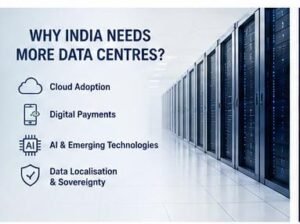
India is one of the world’s largest generators of digital data, accounting for nearly 20% of global data creation, yet it possesses only around 3–4% of global data Centre capacity. This gap has created enormous opportunities for investment in digital infrastructure. The rapid adoption of cloud services, AI applications, digital banking, online education, gaming, and OTT platforms has significantly increased demand for local data storage and computing power. Additionally, data localisation requirements and concerns over digital sovereignty are encouraging companies to store Indian user data within the country.
India’s installed data Centre capacity has grown dramatically—from approximately 375 MW in 2020 to nearly 1,500 MW by 2025, according to the Ministry of Electronics and Information Technology (MeitY). Industry estimates suggest this capacity could exceed 6 GW by 2030, making India one of Asia’s fastest-growing data Centre markets.
The Major Players Building India’s Digital Infrastructure
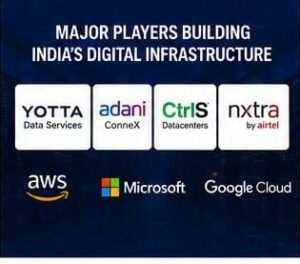
India’s data centre ecosystem includes global technology giants, telecom operators, real estate developers, and large Indian conglomerates.
Yotta Data Services
Yotta Data Services, backed by the Hiranandani Group, has emerged as one of India’s leading hyperscale data centre operators. The company has built large facilities in Navi Mumbai and is investing heavily in AI infrastructure powered by Nvidia GPUs. Yotta has positioned itself as a major player in sovereign cloud and AI computing, serving both domestic and international clients. The company is also preparing for a public listing to fund future expansion.
AdaniConneX
AdaniConneX is one of the most ambitious entrants in India’s data centre market. The company plans to develop large-scale facilities across cities including Chennai, Navi Mumbai, Noida, Hyderabad, Pune, and Kolkata. Adani’s strategy combines renewable energy with digital infrastructure, aiming to create sustainable, energy-efficient data centres. The group has announced investments worth thousands of crores in multiple states.
CtrlS Datacenters
CtrlS Datacenters is among India’s oldest and largest data centre companies. Based in Hyderabad, CtrlS operates facilities in Mumbai, Bengaluru, Chennai, Noida, Kolkata, and Hyderabad. In 2026, it secured an investment commitment of ₹7,000 crore from Canada’s CPP Investments, highlighting growing international confidence in India’s digital infrastructure sector.
Nxtra by Airtel
Nxtra by Airtel is another major player, operating data centers across India. The company plans to nearly double its capacity to around 400 MW by 2027 through investments of approximately $600 million. Airtel’s telecom network provides a strategic advantage in delivering cloud and edge computing services.
Global Tech Giants
International hyperscalers such as Amazon Web Services, Microsoft, and Google are also investing significantly in India. Google announced plans for one of its largest AI data centre projects outside the United States, with a major facility planned in Andhra Pradesh. Global cloud companies are increasingly partnering with Indian firms to build local infrastructure and meet regulatory requirements.
Which Cities Are Becoming Data Centre Hubs?

Mumbai remains India’s largest data centre market due to its proximity to submarine cable landing stations that connect India to global internet networks. Chennai is rapidly emerging as another key hub because of similar connectivity advantages. Hyderabad, Bengaluru, Delhi-NCR, Pune, and Kolkata are also witnessing substantial investments.
More than 65% of India’s data centre capacity is concentrated in Mumbai, Chennai, Bengaluru, Hyderabad, and Delhi-NCR. However, companies are increasingly exploring Tier-2 cities for edge data centres, which reduce latency and improve digital services closer to users.
AI Is Creating a New Wave of Demand

Artificial intelligence is transforming the data centre industry. AI applications require immense computing power, specialised processors, and high-density infrastructure. India’s AI market is expected to reach $20–22 billion by 2027, creating additional demand for AI-ready data centres. To support this ecosystem, India has already onboarded more than 38,000 GPUs through various data centre service providers under national AI initiatives.
As AI workloads grow, data centres are shifting from simple storage facilities to advanced compute hubs capable of supporting machine learning, generative AI, and large language models.
The Challenges Ahead

Despite the rapid growth, India’s data centre industry faces several challenges. Data centres consume large amounts of electricity and water, making sustainability a key concern. By 2030, the sector could account for around 3% of India’s electricity consumption. Operators are therefore investing in renewable energy, efficient cooling technologies, and green building practices.
Power availability, land acquisition, and high infrastructure costs also remain important considerations. Building AI-ready facilities requires significant capital, with costs continuing to rise globally. However, government incentives, tax benefits, and state-level policies are helping attract investments.
Conclusion

India’s data centre boom represents far more than a real estate trend—it is the foundation of the country’s digital future. As AI, cloud computing, and digital services become central to economic growth, data centres are emerging as strategic national assets, comparable to roads, ports, and power grids.
Companies such as Yotta, AdaniConneX, CtrlS, Nxtra, and global hyperscalers are investing billions of dollars to build this digital infrastructure. With projected investments exceeding $50–90 billion over the coming years, India is positioning itself not only as a major consumer of digital services but also as one of the world’s most important destinations for data storage, cloud infrastructure, and AI computing.