


Introduction
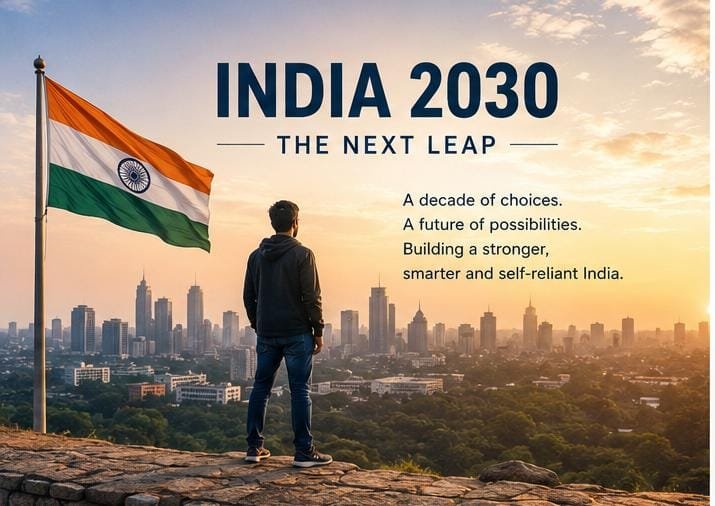
2030 is not a magic number. It will not suddenly transform India when the calendar reaches it. But it gives us something valuable: a deadline against which we can examine the choices India is making today. The India of 2030 will inherit a world shaped by artificial intelligence, automation, geopolitical competition, changing supply chains, clean energy and new forms of work. Technologies that are still emerging today could become ordinary parts of business and everyday life. Companies may operate with smaller teams; factories may become more automated and skills that are valuable today may not carry the same value a decade from now.
For India, this creates both an opportunity and a challenge.
The country has already demonstrated that it can build and deploy technology at enormous scale. Its services industry created globally competitive companies in software, consulting, pharmaceuticals, financial services and business-process management. Then came the digital transformation. Cheap mobile connectivity, digital payments and digital public infrastructure changed how millions of Indians access financial services, communicate and participate in the economy. But the next challenge is bigger. Can India build the technologies behind the next wave of economic growth rather than simply consume them?
That ambition is increasingly visible. India is investing attention and resources into semiconductors, electronics manufacturing, artificial intelligence, robotics, biotechnology, space technology, renewable energy and advanced manufacturing. Deep-tech entrepreneurship is also receiving greater policy attention, particularly because companies working on difficult technologies require something very different from conventional startups: specialized talent, intellectual property, patient capital and years of research and development. The National Deep Tech Startup Policy reflects this emerging approach. Instead of focusing only on creating more startups, the larger goal is to create companies capable of developing technologies that can compete globally.
This changes the way we should think about India 2030.
The question is no longer simply whether India will become richer or larger. It is whether India can move up the value chain—from consumer to creator, from service provider to technology builder, and from a major market to a major source of globally competitive products and innovation.
From Digital India to Product India
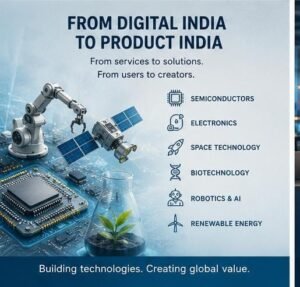
India’s first major technology advantage was its ability to provide services to the world. Indian companies built a strong global reputation in IT services, pharmaceuticals, financial services and consumer technology. But the next opportunity could be different. Instead of primarily providing services around technology, India could increasingly become a country that builds products, technologies and intellectual property for global markets.
This shift is already visible in the areas India is trying to develop. Semiconductors, electronics, defence technology, space, biotechnology, robotics and artificial intelligence are significantly more complex than many of the industries that powered India’s earlier technology boom. The semiconductor industry is particularly important because India’s ambition is not simply to assemble more electronic devices. The larger goal is to participate in the ecosystem behind them, including chip design, manufacturing, packaging, testing, equipment, research and specialised talent.
The importance of semiconductors becomes clearer when we consider how many industries depend on them. Smartphones, electric vehicles, medical devices, telecommunications equipment, defence systems, data centres and AI infrastructure all require chips. This means India’s semiconductor ambitions are ultimately about much more than semiconductors. They are about whether India can develop the industrial capabilities required to participate in the next generation of global technology.
The Startup Story Is Changing

India’s startup ecosystem has already become one of the world’s largest, but the next chapter could look very different from the previous one. The earlier startup wave was heavily influenced by consumer internet businesses such as food delivery, ride-hailing, e-commerce, digital payments and online education. These businesses changed how millions of Indians shop, travel, learn and transact.
The next generation of startups could increasingly focus on technologies that are much harder to build. Imagine an Indian company developing industrial robotics, a startup working on semiconductor technology, a company building satellites or a deep-tech business working on biotechnology, advanced materials or defence technology. These companies cannot always be built in six months. They may require laboratories, engineers, scientists, manufacturing facilities, specialised equipment and years of research before they can become commercially successful.
That is why India’s deep-tech ambitions matter. The National Deep Tech Startup Policy focuses on challenges such as long development cycles, access to patient capital, intellectual property, research capabilities and specialised talent. A deep-tech company cannot always be judged using the same timeline as a conventional software startup. This could eventually change the way India’s startup ecosystem measures success. By 2030, the important question may not simply be how many startups India has created, but how many globally important technologies and companies it has managed to build.
AI Could Become India’s Productivity Layer
Artificial intelligence is likely to become one of the most important forces shaping India’s economy by 2030. However, India’s AI opportunity should not be understood only through chatbots, large language models and consumer applications. One of the more significant opportunities could come from applying AI across the existing economy and helping millions of businesses become more productive.
India’s MSMEs are particularly important in this context. According to the World Economic Forum, India’s MSMEs contribute nearly 30% of GDP and support more than 230 million jobs. The organization estimates that AI could unlock more than $500 billion in economic value for India’s MSME sector. This creates a much bigger AI story than simply asking which chatbot is the most advanced. The more important question is what happens when ordinary businesses begin using AI to improve the way they operate.
A small manufacturing company could use AI to detect quality problems on a production line. Predictive maintenance could identify when a machine is likely to fail and reduce unexpected downtime. Software could automatically analyse invoices, forecast inventory and identify unusual transactions. These may sound like relatively small improvements, but when multiplied across millions of businesses, they could have a significant effect on India’s overall productivity. In February 2026, the World Economic Forum highlighted edge AI as a potential pathway for Indian MSMEs to improve areas such as quality control, machine maintenance, compliance and energy efficiency. India’s AI opportunity could therefore come not only from building AI models but from using AI to improve the productivity of businesses that already form the foundation of the economy.
Manufacturing Could Become India’s Next Big Test
India cannot build a large and resilient economy through services alone. Manufacturing matters because it connects investment, exports, employment, technology and supply chains. The global manufacturing environment is also changing as companies reconsider where they produce goods because of geopolitical tensions, trade restrictions and supply-chain vulnerabilities. This creates an opportunity for India, but opportunity alone does not guarantee success.
Building a factory is relatively easy compared with building an entire manufacturing ecosystem. A competitive industrial ecosystem requires suppliers, skilled workers, logistics networks, ports, reliable energy, research institutions, financing and companies capable of producing increasingly sophisticated components. The semiconductor industry demonstrates this perfectly. A chip fabrication facility cannot operate in isolation. It requires equipment, materials, engineers, testing facilities, specialised suppliers and infrastructure around it. The same principle applies to electric vehicles, electronics, aerospace and other advanced manufacturing industries.
This means India’s manufacturing challenge by 2030 will be bigger than simply achieving the ambition of “Make in India.” The more important question will be how much of the value chain India can actually capture. Can Indian companies design products, manufacture components, develop the underlying technology, own intellectual property and ultimately sell those products to global customers? The more of this value chain India can control, the greater the long-term economic impact of manufacturing is likely to be.
The Workforce Question
Every economic transformation eventually becomes a workforce transformation. India has a huge working-age population, and this is often described as one of the country’s biggest advantages. But demographics alone do not create prosperity. People need skills that match the economy being built around them, and those skills will need to change as technology changes.
This is particularly important as AI begins to transform knowledge work. India’s IT industry has been one of the country’s most important engines of services exports and professional employment for decades. However, generative AI is changing the economics of software development and outsourcing, creating pressure for companies and workers to move towards higher-value forms of work. The most useful question is therefore not simply whether AI will eliminate jobs. It is what happens when the tasks inside existing jobs change faster than workers can adapt.
A recent PwC India–FICCI report found that while 90% of India’s Global Capability Centre leaders expressed confidence in their strategic position through 2030, AI literacy among the workforce was only 27%. That gap illustrates an important challenge. India may have millions of educated workers, but education alone will not guarantee employability in an AI-driven economy. The workers who thrive by 2030 may increasingly be those who combine domain expertise with technology, communication, problem-solving and the ability to keep learning throughout their careers.
India 2030 Will Not Be Built Only in Bengaluru
India’s technology economy has traditionally been concentrated around cities such as Bengaluru, Hyderabad, Mumbai, Delhi and Chennai. These cities will remain important, but India’s next phase of growth could gradually become more geographically distributed. Digital infrastructure, improved connectivity, manufacturing clusters and remote collaboration are making it possible for more businesses to operate successfully outside the traditional technology hubs.
A startup does not necessarily need to be headquartered in Bengaluru to build software for a global market. A manufacturing company can develop around an industrial cluster, while a specialised technology company can grow around a university or research institution. If more such ecosystems emerge, the result could be much bigger than startup growth. It could influence employment, migration, education, housing, local consumption and infrastructure across the country. India’s next decade could therefore see more regional economic centres emerge rather than having a small number of cities absorb a disproportionate share of the country’s technology talent, capital and opportunity.
Growth Will Need More Energy
There is another part of the India 2030 equation that is easy to overlook: energy. A larger economy requires more electricity. Factories need reliable power, electric vehicles need charging infrastructure, cities require increasing amounts of cooling, and data centres need enormous quantities of electricity. Artificial intelligence also requires computing infrastructure, and computing infrastructure ultimately requires energy.
This creates an important challenge for India. The country wants faster economic growth and greater industrialization while also expanding renewable energy and reducing the carbon intensity of development. Energy therefore cannot be treated as a separate issue from technology and economic growth. It is part of the same story. The availability and cost of electricity could influence where data centres are built, where factories locate, how competitive Indian exports become and how quickly electric mobility expands. By 2030, energy could be just as important to India’s technology ambitions as talent and capital.
What Does India 2030 Actually Mean?
So, what exactly do we mean when we talk about India 2030? It is not a prediction that India will suddenly become a completely different country on January 1, 2030. Instead, it is a framework for examining a transition that is already underway.
It is a transition from a largely service-driven technology story towards a broader economy built around services, manufacturing, technology, intellectual property and innovation. It is a transition from simply consuming digital products towards building more of the infrastructure and technology behind them. It is a transition from AI being an experimental tool used by a relatively small number of companies towards AI becoming part of everyday business operations. It is also a transition from a startup ecosystem dominated by consumer internet businesses towards one that could increasingly include deep tech, industrial technology and scientific innovation.
Perhaps the biggest shift, however, is in how India thinks about its workforce. Instead of asking only how many people the economy can employ, the more important question may become whether India can make its enormous workforce significantly more productive. That will depend on education, skills, technology, infrastructure, business investment and the ability of workers to continuously adapt.
But 2030 Is Not Guaranteed
There is a temptation whenever discussing India’s future to turn the conversation into a prediction of inevitable success. That would miss the point. India has enormous opportunities, but it also faces significant challenges. Infrastructure needs to improve, skills need to keep pace with technology, manufacturing ecosystems need to deepen, research needs stronger links with commercialization, businesses need to become more productive and cities need better planning. Energy demand will continue to rise, while technological progress itself will create both opportunities and disruption.
The next few years will therefore not simply be a story of opportunity. They will also be a test of execution. India has already demonstrated that it can build digital systems at extraordinary scale. The next challenge is whether it can translate that ability into productivity, innovation, manufacturing and globally competitive products.
The India 2030 Question
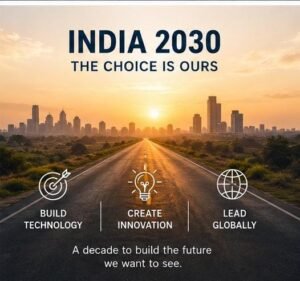
Perhaps the most useful way to think about India 2030 is not to ask, “How big will India become?” Instead, the more interesting question is, “What will India become good at?” Will Indian companies become better at building advanced products? Will startups become globally important technology companies? Will AI make millions of small businesses more productive? Will manufacturing become a larger engine of employment and exports? Will India’s workforce acquire the skills required by an increasingly automated economy? Will smaller cities become meaningful centres of entrepreneurship and innovation? And can India achieve all of this while keeping growth inclusive and sustainable?
These questions will shape the next phase of India’s development. India 2030 is not about looking into a crystal ball or predicting exactly what the country will look like at the end of the decade. It is about examining the decisions being made today and understanding what they could mean for the India that emerges tomorrow. The future will be shaped by choices about technology, businesses, infrastructure, skills, energy, manufacturing and innovation.
Over the coming articles, the India 2030 series will explore the forces behind that transformation, including startups, artificial intelligence, manufacturing, semiconductors, deep technology, jobs, energy, cities and the businesses that could define India’s next economic chapter. Because the most important question about India’s future is not whether change is coming. It is whether India can build fast enough, learn fast enough and adapt fast enough to shape that change on its own terms.