


Introduction
Traditional startups relied on one critical resource: capital. Hiring engineers, marketers, designers, analysts, and support teams required significant investment, making venture funding almost essential for rapid growth.
Artificial intelligence is changing that equation- Modern AI tools can automate coding, content creation, customer service, market research, and business operations, dramatically reducing both costs and time-to-market. Founders can now accomplish work that previously required entire departments. This shift has lowered one of the biggest barriers to entrepreneurship—the cost of execution. As a result, using AI to accomplish exponentially more with the same resources.
The Evolution of Bootstrapping
Traditional bootstrapping required entrepreneurs to manage nearly every business function manually. Founders were responsible for software development, marketing, design, customer service, operations, research, and administrative work, often with limited budgets and little external support. Artificial intelligence has fundamentally changed this operating model. Rather than replacing human decision-making, AI enhances founder productivity by automating routine tasks and accelerating complex workflows. Entrepreneurs can now perform responsibilities that previously required multiple specialists across engineering, marketing, finance, customer support, and operations. The result is a dramatic increase in individual productivity and a significant reduction in startup operating costs.
AI Is Changing the Economics of Entrepreneurship

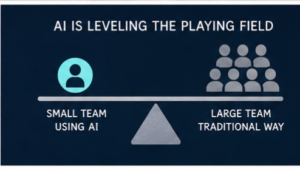
The financial barriers to launching a startup have never been lower. Modern AI tools reduce the time and cost required to develop products, market them, and operate a business. OpenAI CEO Sam Altman has noted that AI significantly lowers the cost of intelligence-based work, enabling entrepreneurs to accomplish more with fewer people. Venture capital firm Andreessen Horowitz (a16z) has observed a similar trend, highlighting that AI-native startups are reaching impressive revenue milestones with remarkably lean teams. Investors increasingly describe these businesses as “small teams with massive output.”
The broader economic impact reinforces this shift:
- McKinsey estimates that generative AI could add between $2.6 trillion and $4.4 trillion to the global economy each year through productivity gains.
- Goldman Sachs projects AI could increase global GDP by 7% over the coming decade while significantly improving labor productivity.
- Microsoft’s 2024 Work Trend Index reports that professionals using AI complete knowledge-intensive work faster and spend more time on strategic activities.
For bootstrapped founders, these productivity gains translate directly into lower costs, faster execution, and greater flexibility.
Rule #1: Build Before You Raise
The traditional startup playbook encouraged founders to secure funding before building a product.
AI has flipped that approach.
Entrepreneurs can now validate ideas with minimal upfront investment by using AI to generate code, design interfaces, produce marketing content, launch landing pages, and test customer demand within days instead of months. By proving market interest before making major financial commitments, founders reduce risk while increasing their chances of attracting investors later. Today, traction often speaks louder than a polished pitch deck.
Real-World Example: Pieter Levels
Serial entrepreneur Pieter Levels has become one of the strongest examples of AI-enabled bootstrapping. As the creator of platforms such as Nomad List, Remote OK, and several AI-powered products, Levels has consistently built profitable businesses without relying on venture capital. Working primarily as a solo founder, he uses AI and automation to accelerate software development, streamline customer support, eliminate repetitive work, and rapidly test new ideas. His companies generate millions in annual recurring revenue while operating with exceptionally small teams—a powerful demonstration that in today’s startup landscape, speed, efficiency, and execution often matter more than company size.
Rule #2: Replace Processes Before Hiring People
Hiring has traditionally been the default solution whenever startups become overwhelmed. But in the AI era, many operational challenges can be solved with automation instead of additional headcount. Rather than recruiting a customer support representative, businesses can deploy AI assistants that resolve common questions around the clock. Instead of outsourcing content creation or data reporting, founders can use AI to produce first drafts, summarize insights, and automate recurring workflows. Companies that automate first often reach profitability sooner because they postpone hiring until business growth genuinely demands specialized human expertise.
Real Example: Klarna
Fintech company Klarna showed how AI can transform customer support. Its virtual assistant was able to resolve millions of customer conversations while reducing operational costs and shortening response times. The example illustrates that AI isn’t simply about reducing expenses—it’s about delivering faster, more scalable service without sacrificing quality.
Rule #3: Treat AI as Your First Employee
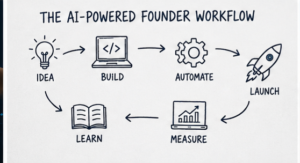
Today’s startups often begin with an unusual first hire: artificial intelligence. Instead of relying on employees for every operational task, founders create AI workflows that support marketing, research, customer service, administration, and internal operations. This allows entrepreneurs to run lean businesses while maintaining professional standards across multiple business functions
Rule #4: Build Distribution Alongside the Product
Building an exceptional product is only half the challenge. If potential customers never discover it, even the best solution can struggle to grow.AI enables founders to consistently produce educational content, newsletters, social media posts, product tutorials, and SEO articles without requiring a dedicated marketing department. Consistent publishing increases visibility, builds trust, and creates multiple channels through which customers can find the business. In today’s competitive market, discoverability is often as important as innovation.
Real Example: Gamma
Rather than relying heavily on paid advertising, Gamma expanded through viral product experiences and strong content marketing. Every presentation created by a user became an opportunity to introduce new people to the platform, showing how product design itself can become a powerful distribution channel.
Rule #5: Optimize for Speed, Not Perfection
Modern startups succeed by learning quickly, not by getting everything right on the first attempt.AI allows founders to launch, measure, refine, and repeat at an unprecedented pace. Every experiment generates insights, and those insights compound into better products and stronger business decisions over time.
Rule #6: Small Teams Can Scale Globally
One of the biggest advantages of AI is that it removes many of the traditional barriers to global growth. With automation handling customer support, translations, documentation, and routine operations, founders can deliver consistent customer experiences around the world without dramatically increasing costs. The result is a business that scales through systems rather than headcount, allowing entrepreneurs to focus on sustainable and profitable growth.
The Rise of the Solo Founder
One of the most significant trends in entrepreneurship is the emergence of the “solo fouder with AI.”
These entrepreneurs use AI to:
- Build products
- Write code
- Produce marketing content
- Analyze financial data
- Manage customer relationships
- Conduct research
- Automate operations
While not every company can be built by one person, many software, media, consulting, and digital product businesses can now reach meaningful scale before hiring large teams.This model is attracting increasing attention from investors and startup communities alike.
What AI Still Cannot Replace
Despite its capabilities, AI is not a substitute for entrepreneurial judgment.
Successful founders still need to provide:
- Strategic decision-making
- Vision
- Creativity
- Customer empathy
- Leadership
- Negotiation
- Relationship building
- Ethical oversight
AI accelerates execution—but it does not define direction.The founders who combine human insight with AI-powered execution will retain the greatest competitive advantage.
Common Mistakes Founders Make
Many entrepreneurs misunderstand how to integrate AI into their businesses.
Common pitfalls include:
- Using AI without validating customer demand
- Automating poor processes instead of improving them
- Publishing generic AI-generated content without adding expertise
- Ignoring brand differentiation
- Relying entirely on automation for customer relationships
AI should enhance human expertise, not replace authenticity.
The Future of Bootstrapping
The next generation of successful startups will likely look very different from those of the past decade.Instead of measuring success by employee count or funding rounds, founders will increasingly focus on:
- Revenue per employee
- Profitability
- Automation maturity
- Customer satisfaction
- Execution speed
- Sustainable growth
AI is making lean businesses more competitive than ever before.Companies that embrace AI strategically can reach global markets faster, operate more efficiently, and remain independent for longer.
Conclusion

Bootstrapping has entered a new era. Artificial intelligence has reduced the barriers to building, marketing, and operating a business, allowing founders to achieve more with fewer resources. The entrepreneurs who succeed will not simply be those who adopt AI tools—they will be those who redesign their businesses around AI-enabled workflows while preserving the uniquely human strengths of vision, creativity, and trust.The future belongs to founders who can combine technology with thoughtful leadership. In the AI era, success is no longer defined by the size of your team or the amount of capital you raise. It is defined by how effectively you use intelligence—both artificial and human—to create value.