


Introduction
Markets are evolving faster than ever, customer expectations continue to shift, and technological disruption has become the new normal. In this environment, business decision making is emerging as one of the most valuable competitive advantages an organization can possess. Explore how AI in business, organizational intelligence, predictive analytics, and data-driven decision-making empower leaders to identify opportunities, reduce risk, improve business ability, and build resilient organizations that thrive in an increasingly complex and competitive world.
Every Business Has More Data Than Ever Before
Businesses have access to more data than ever before.Every customer interaction, transaction, website visit, financial report, and AI system generates valuable information. Yet despite this explosion of data, many organizations still struggle to make faster, better decisions. According to IDC, the global datasphere is projected to exceed 175 zettabytes, illustrating how rapidly enterprise data continues to grow.
Instead of creating clarity, too much information often leads to analysis paralysis. Teams spend weeks reviewing reports and debating metrics while opportunities slip away. Data alone isn’t a competitive advantage. The ability to turn it into timely action is.
Amazon demonstrates this well by continuously analyzing customer demand, inventory levels, and purchasing behavior in real time. Rather than waiting for monthly reports, the company uses data-driven insights to optimize inventory and improve delivery speed, allowing it to respond to customer demand almost instantly.
Speed Is Quietly Replacing Size
Scale once defined market leadership, but speed is becoming the new differentiator. As technology reduces the advantages of size, organizations that can make high-quality decisions quickly are gaining the upper hand. The businesses that respond first—not just the ones with the most resources—are increasingly shaping the future of their industries.
Fashion retailer Zara is a well-known example. By closely monitoring customer demand and rapidly adjusting production, Zara can move new designs from concept to stores within weeks, allowing it to respond to changing trends much faster than traditional fashion brands. Research from McKinsey also suggests that organizations capable of making fast, high-quality decisions consistently outperform slower competitors in growth and operational performance.
AI Is Changing the Economics of Decision-Making
Artificial intelligence is no longer just improving productivity—it is transforming how businesses make decisions. By analyzing vast amounts of data, identifying patterns, and predicting outcomes in real time, AI enables organizations to act faster and with greater confidence. Rather than replacing human judgment, it equips leaders with better insights to make smarter decisions.
Netflix, for example, analyzes billions of viewing signals to personalize recommendations for every user, while UPS uses AI-powered route optimization to reduce delivery times and fuel consumption. These organizations demonstrate that AI’s greatest value often lies in improving thousands of operational decisions every single day.
The Cost of Slow Decisions Is Growing
Waiting for perfect certainty has become a business risk. Companies that respond quickly to change consistently outperform those that spend too long analyzing every possibility. Speed, when supported by good data, has become a strategic advantage.
In today’s fast-moving markets, delays can be expensive. Whether responding to changing customer demand, supply chain disruptions, or competitive threats, organizations that hesitate often miss opportunities. Businesses that empower teams with real-time insights are far better positioned to adapt before competitors do.
Decision Intelligence Is Becoming a Business Discipline
Organizations are moving beyond traditional analytics toward Decision Intelligence—a discipline that combines AI, data, human expertise, and business strategy to improve decision-making. The goal isn’t better reports; it’s better actions.
Gartner identifies Decision Intelligence as an emerging business discipline that connects analytics with decision science to improve organizational outcomes. Instead of simply understanding what happened, organizations increasingly use predictive analytics to determine what is most likely to happen next and what action should be taken.
Better Decisions Create Better Customer Experiences

Every customer experience is shaped by countless business decisions. Faster responses, accurate deliveries, personalized recommendations, and reliable service all result from org Streaming anizations that make informed decisions quickly and consistently.
platforms like Netflix and Spotify use data-driven decision-making to personalize content recommendations, while logistics companies such as UPS optimize delivery routes using predictive analytics. Customers may never see these systems, but they experience the results through faster service, greater convenience, and more relevant experiences.
The Future Belongs to Organizations That Decide Better
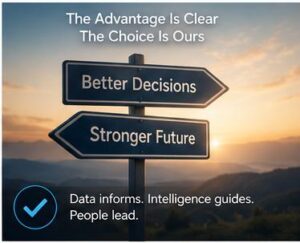
As AI continues to automate routine work, human judgment becomes even more valuable. The organizations that succeed won’t be those with the most data—they’ll be the ones that can turn data into action faster than everyone else.
As advanced technologies become more accessible, competitive advantage will increasingly depend on how effectively organizations integrate AI, analytics, and human expertise into everyday decision-making. Businesses that continuously learn from their decisions will be better equipped to innovate, adapt, and remain resilient in an increasingly competitive world.
Conclusion
The businesses that lead tomorrow will be those that treat decision-making as a strategic advantage. By combining human expertise with AI-driven insights, they can respond faster, innovate more effectively, and build long-term resilience in an increasingly unpredictable world.In the years ahead, success will depend less on having access to more information and more on making better use of it. Organizations that can consistently transform data into confident, timely decisions will be the ones shaping the future of their industries.